Wednesday, July 20, 2016

This Guy Trains Computers to Find Future Criminals (BW)

Richard Berk says his algorithms take the bias out of criminal justice. But could they make it worse? 
by Joshua Brustein July 18, 2016

When historians look back at the turmoil over prejudice and policing in the U.S. over the past few years, they’re unlikely to dwell on the case of Eric Loomis. Police in La Crosse, Wis., arrested Loomis in February 2013 for driving a car that was used in a drive-by shooting. He had been arrested a dozen times before. Loomis took a plea, and was sentenced to six years in prison plus five years of probation.

The episode was unremarkable compared with the deaths of Philando Castile and Alton Sterling at the hands of police, which were captured on camera and distributed widely online. But Loomis’s story marks an important point in a quieter debate over the role of fairness and technology in policing. Before his sentence, the judge in the case received an automatically generated risk score that determined Loomis was likely to commit violent crimes in the future.

Risk scores, generated by algorithms, are an increasingly common factor in sentencing. Computers crunch data—arrests, type of crime committed, and demographic information—and a risk rating is generated. The idea is to create a guide that’s less likely to be subject to unconscious biases, the mood of a judge, or other human shortcomings. Similar tools are used to decide which blocks police officers should patrol, where to put inmates in prison, and who to let out on parole. Supporters of these tools claim they’ll help solve historical inequities, but their critics say they have the potential to aggravate them, by hiding old prejudices under the veneer of computerized precision. Some people see them as a sterilized version of what brought protesters into the streets at Black Lives Matter rallies.

Loomis is a surprising fulcrum in this controversy: He’s a white man. But when Loomis challenged the state’s use of a risk score in his sentence, he cited many of the fundamental criticisms of the tools: that they’re too mysterious to be used in court, that they punish people for the crimes of others, and that they hold your demographics against you. Last week the Wisconsin Supreme Court ruled against Loomis, but the decision validated some of his core claims. The case, say legal experts, could serve as a jumping-off point for legal challenges questioning the constitutionality of these kinds of techniques.

To understand the algorithms being used all over the country, it’s good to talk to Richard Berk. He’s been writing them for decades (though he didn’t write the tool that created Loomis’s risk score). Berk, a professor at the University of Pennsylvania, is a shortish, bald guy, whose solid stature and I-dare-you-to-disagree-with-me demeanor might lead people to mistake him for an ex-cop. In fact, he’s a career statistician.

His tools have been used by prisons to determine which inmates to place in restrictive settings; parole departments to choose how closely to supervise people being released from prison; and police officers to predict whether people arrested for domestic violence will re-offend. He once created an algorithm that would tell the Occupational Safety and Health Administration which workplaces were likely to commit safety violations, but says the agency never used it for anything. Starting this fall, the state of Pennsylvania plans to run a pilot program using Berk’s system in sentencing decisions.

As his work has been put into use across the country, Berk’s academic pursuits have become progressively fantastical. He’s currently working on an algorithm that he says will be able to predict at the time of someone’s birth how likely she is to commit a crime by the time she turns 18. The only limit to applications like this, in Berk’s mind, is the data he can find to feed into them.

“The policy position that is taken is that it’s much more dangerous to release Darth Vader than it is to incarcerate Luke Skywalker”

This kind of talk makes people uncomfortable, something Berk was clearly aware of on a sunny Thursday morning in May as he headed into a conference in the basement of a campus building at Penn to play the role of least popular man in the room. He was scheduled to participate in the first panel of the day, which was essentially a referendum on his work. Berk settled into his chair and prepared for a spirited debate about whether what he does all day is good for society.

The moderator, a researcher named Sandra Mayson, took the podium. “This panel is the Minority Report panel,” she said, referring to the Tom Cruise movie where the government employs a trio of psychic mutants to identify future murderers, then arrests these “pre-criminals” before their offenses occur. The comparison is so common it’s become a kind of joke. “I use it too, occasionally, because there’s no way to avoid it," Berk said later.

For the next hour, the other members of the panel took turns questioning the scientific integrity, utility, and basic fairness of predictive techniques such as Berk’s. As it went on, he began to fidget in frustration. Berk leaned all the way back in his chair and crossed his hands over his stomach. He leaned all the way forward and flexed his fingers. He scribbled a few notes. He rested his chin in one hand like a bored teenager and stared off into space.

Eventually, the debate was too much for him: “Here’s what I, maybe hyperbolically, get out of this,” Berk said. “No data are any good, the criminal justice system sucks, and all the actors in the criminal justice system are biased by race and gender. If that’s the takeaway message, we might as well all go home. There’s nothing more to do.” The room tittered with awkward laughter.

Berk’s work on crime started in the late 1960s, when he was splitting his time between grad school and a social work job in Baltimore. The city exploded in violence following the assassination of Martin Luther King Jr. Berk’s graduate school thesis examined the looting patterns during the riots. “You couldn’t really be alive and sentient at that moment in time and not be concerned about what was going on in crime and justice,” he said. “Very much like today with the Ferguson stuff.”

In the mid-1990s, Berk began focusing on machine learning, where computers look for patterns in data sets too large for humans to sift through manually. To make a model, Berk inputs tens of thousands of profiles into a computer. Each one includes the data of someone who has been arrested, including how old they were when first arrested, what neighborhood they’re from, how long they’ve spent in jail, and so on. The data also contain information about who was re-arrested. The computer finds patterns, and those serve as the basis for predictions about which arrestees will re-offend.

To Berk, a big advantage of machine learning is that it eliminates the need to understand what causes someone to be violent. “For these problems, we don’t have good theory,” he said. Feed the computer enough data and it can figure it out on its own, without deciding on a philosophy of the origins of criminal proclivity. This is a seductive idea. But it’s also one that comes under criticism each time a supposedly neutral algorithm in any field produces worryingly non-neutral results. In one widely cited study, researchers showed that Google’s automated ad-serving software was more likely to show ads for high-paying jobs to men than to women. Another found that ads for arrest records show up more often when searching the web for distinctly black names than for white ones.

Computer scientists have a maxim, “Garbage in, garbage out.” In this case, the garbage would be decades of racial and socioeconomic disparities in the criminal justice system. Predictions about future crimes based on data about historical crime statistics have the potential to equate past patterns of policing with the predisposition of people in certain groups—mostly poor and nonwhite—to commit crimes.

Berk readily acknowledges this as a concern, then quickly dismisses it. Race isn’t an input in any of his systems, and he says his own research has shown his algorithms produce similar risk scores regardless of race. He also argues that the tools he creates aren’t used for punishment—more often they’re used, he said, to reverse long-running patterns of overly harsh sentencing, by identifying people whom judges and probation officers shouldn’t worry about.

Berk began working with Philadelphia’s Adult Probation and Parole Department in 2006. At the time, the city had a big murder problem and a small budget. There were a lot of people in the city’s probation and parole programs. City Hall wanted to know which people it truly needed to watch. Berk and a small team of researchers from the University of Pennsylvania wrote a model to identify which people were most likely to commit murder or attempted murder while on probation or parole. Berk generally works for free, and was never on Philadelphia’s payroll.

A common question, of course, is how accurate risk scores are. Berk says that in his own work, between 29 percent and 38 percent of predictions about whether someone is low-risk end up being wrong. But focusing on accuracy misses the point, he says. When it comes to crime, sometimes the best answers aren’t the most statistically precise ones. Just like weathermen err on the side of predicting rain because no one wants to get caught without an umbrella, court systems want technology that intentionally overpredicts the risk that any individual is a crime risk. The same person could end up being described as either high-risk or not depending on where the government decides to set that line. “The policy position that is taken is that it’s much more dangerous to release Darth Vader than it is to incarcerate Luke Skywalker,” Berk said.

“Every mark of poverty serves as a risk factor”

Philadelphia’s plan was to offer cognitive behavioral therapy to the highest-risk people, and offset the costs by spending less money supervising everyone else. When Berk posed the Darth Vader question, the parole department initially determined it’d be 10 times worse, according to Geoffrey Barnes, who worked on the project. Berk figured that at that threshold the algorithm would name 8,000 to 9,000 people as potential pre-murderers. Officials realized they couldn’t afford to pay for that much therapy, and asked for a model that was less harsh. Berk’s team twisted the dials accordingly. “We’re intentionally making the model less accurate, but trying to make sure it produces the right kind of error when it does,” Barnes said.

The program later expanded to group everyone into high-, medium-, and low-risk populations, and the city significantly reduced how closely it watched parolees Berk’s system identified as low-risk. In a 2010 study, Berk and city officials reported that people who were given more lenient treatment were less likely to be arrested for violent crimes than people with similar risk scores who stayed with traditional parole or probation. People classified as high-risk were almost four times more likely to be charged with violent crimes.

Since then, Berk has created similar programs in Maryland’s and Pennsylvania’s statewide parole systems. In Pennsylvania, an internal analysis showed that between 2011 and 2014 about 15 percent of people who came up for parole received different decisions because of their risk scores. Those who were released during that period were significantly less likely to be re-arrested than those who had been released in years past. The conclusion: Berk’s software was helping the state make smarter decisions.

Laura Treaster, a spokeswoman for the state’s Board of Probation and Parole, says Pennsylvania isn’t sure how its risk scores are impacted by race. “This has not been analyzed yet,” she said. “However, it needs to be noted that parole is very different than sentencing. The board is not determining guilt or innocence. We are looking at risk.”

Sentencing, though, is the next frontier for Berk’s risk scores. And using algorithms to decide how long someone goes to jail is proving more controversial than using them to decide when to let people out early.

Wisconsin courts use Compas, a popular commercial tool made by a Michigan-based company called Northpointe. By the company’s account, the people it deems high-risk are re-arrested within two years in about 70 percent of cases. Part of Loomis’s challenge was specific to Northpointe’s practice of declining to share specific information about how its tool generates scores, citing competitive reasons. Not allowing a defendant to assess the evidence against him violated due process, he argued. (Berk shares the code for his systems, and criticizes commercial products such as Northpointe’s for not doing the same.)

As the court was considering Loomis’s appeal, the journalism website ProPublica published an investigation looking at 7,000 Compas risk scores in a single county in Florida over the course of 2013 and 2014. It found that black people were almost twice as likely as white people to be labeled high-risk, then not commit a crime, while it was much more common for white people who were labeled low-risk to re-offend than black people who received a low-risk score. Northpointe challenged the findings, saying ProPublica had miscategorized many risk scores and ignored results that didn’t support its thesis. Its analysis of the same data found no racial disparities.

Even as it upheld Loomis’s sentence, the Wisconsin Supreme Court cited the research on race to raise concerns about the use of tools like Compas. Going forward, it requires risk scores to be accompanied by disclaimers about their nontransparent nature and various caveats about their conclusions. It also says they can’t be used as the determining factor in a sentencing decision. The decision was the first time that such a high court had signaled ambivalence about the use of risk scores in sentencing.

Sonja Starr, a professor at the University of Michigan’s law school and a prominent critic of risk assessment, thinks that Loomis’s case foreshadows stronger legal arguments to come. Loomis made a demographic argument, saying that Compas rated him as riskier because of his gender, reflecting the historical patterns of men being arrested at higher rates than women. But he didn’t frame it as an argument that Compas violated the Equal Protection Clause of the 14th Amendment, which allowed the court to sidestep the core issue.

Loomis also didn’t argue that the risk scores serve to discriminate against poor people. “That’s the part that seems to concern judges, that every mark of poverty serves as a risk factor,” Starr said. “We should very easily see more successful challenges in other cases.”

Officials in Pennsylvania, which has been slowly preparing to use risk assessment in sentencing for the past six years, are sensitive to these potential pitfalls. The state’s experience shows how tricky it is to create an algorithm through the public policy process. To come up with a politically palatable risk tool, Pennsylvania established a sentencing commission. It quickly rejected commercial products like Compas, saying they were too expensive and too mysterious, so the commission began creating its own system.

“If you want me to do a totally race-neutral forecast, you’ve got to tell me what variables you’re going to allow me to use, and nobody can, because everything is confounded with race and gender”

Race was discarded immediately as an input. But every other factor became a matter of debate. When the state initially wanted to include location, which it determined to be statistically useful in predicting who would re-offend, the Pennsylvania Association of Criminal Defense Lawyers argued that it was a proxy for race, given patterns of housing segregation. The commission eventually dropped the use of location. Also in question: the system’s use of arrests, instead of convictions, since it seems to punish people who live in communities that are policed more aggressively.

Berk argues that eliminating sensitive factors weakens the predictive power of the algorithms. “If you want me to do a totally race-neutral forecast, you’ve got to tell me what variables you’re going to allow me to use, and nobody can, because everything is confounded with race and gender,” he said.

Starr says this argument confuses the differing standards in academic research and the legal system. In social science, it can be useful to calculate the relative likelihood that members of certain groups will do certain things. But that doesn’t mean a specific person’s future should be calculated based on an analysis of populationwide crime stats, especially when the data set being used reflects decades of racial and socioeconomic disparities. It amounts to a computerized version of racial profiling, Starr argued. “If the variables aren’t appropriate, you shouldn’t be relying on them," she said.

Late this spring, Berk traveled to Norway to meet with a group of researchers from the University of Oslo. The Norwegian government gathers an immense amount of information about the country’s citizens and connects each of them to a single identification file, presenting a tantalizing set of potential inputs.

Torbjørn Skardhamar, a professor at the university, was interested in exploring how he could use machine learning to make long-term predictions. He helped set up Berk’s visit. Norway has lagged behind the U.S. in using predictive analytics in criminal justice, and the men threw around a few ideas.

Berk wants to predict at the moment of birth whether people will commit a crime by their 18th birthday, based on factors such as environment and the history of a new child’s parents. This would be almost impossible in the U.S., given that much of a person’s biographical information is spread out across many agencies and subject to many restrictions. He’s not sure if it’s possible in Norway, either, and he acknowledges he also hasn’t completely thought through how best to use such information.

Caveats aside, this has the potential to be a capstone project of Berk’s career. It also takes all of the ethical and political questions and extends them to their logical conclusion. Even in the movie Minority Report, the government peered only hours into the future—not years. Skardhamar, who is new to these techniques, said he’s not afraid of making mistakes: They’re talking about them now, he said, so they can avoid future errors. “These are tricky questions,” he said, mulling all the ways the project could go wrong. “Making them explicit—that’s a good thing.”


Tuesday, July 19, 2016

ARM's $31 billion takeover shows that information is king

SoftBank is getting a bargain
Image result for ARM Holdings
ARM Holdings, a chip design firm that doesn’t manufacture or sell any chips, has just been bought by SoftBank for a cool $31.4 billion. That’s four times as much as Microsoft paid for Nokia, close to three times Google’s expenditure on Motorola, and an order of magnitude more than Palm cost HP. We think of these other companies as the authors of the mobile world we’re living in, but it’s ARM’s invisible contribution that has proven more influential — and now a lot more valuable — than all of them.

The smartphone revolution of this century might as well be called the ARM takeover. Practically every single phone, tablet, and smartwatch out in the world today runs on a processor using the ARM architecture — which means licensing ARM’s designs and paying royalties for every chip sold. Yes, that includes iPhones, Galaxys, BlackBerrys, Droids, and Lumias: all but the most loyal of Intel acolytes are manufacturing ARM-powered mobile devices. ARM’s portfolio extends beyond mobile processors to include graphics, wireless, and server chips along with physical design blueprints and software development tools. Simply put, if you want to build a mobile device of any kind, you’ll have to deal with ARM.

ARM IS AN INTELLECTUAL PROPERTY POWERHOUSE

ARM’s product is information. The company spends its time and money on R&D, which it converts into successive generations of new mobile processor core and system designs. Its hardware partners would love to be able to build everything themselves, but ARM’s depth and breadth of expertise is such that it’s more efficient to license rather than compete with its technology. With more than 4,500 granted or pending patents, ARM is an intellectual property powerhouse — like a patent troll that isn’t actually trolling, it just develops smart production methods and designs and sells them.

An oft-cited aphorism from Tom Goodwin last year identified one of the prevailing trends of modern tech:

"Uber, the world’s largest taxi company, owns no vehicles. Facebook, the world’s most popular media owner, creates no content. Alibaba, the most valuable retailer, has no inventory. And Airbnb, the world’s largest accommodation provider, owns no real estate. Something interesting is happening."

The "something interesting" is happening behind the scenes of the tech world too. ARM is another of these prospering companies whose profits keep improving even in the absence of any tangible, physical assets. It isn’t chasing consumers directly, but it’s just as much a trader in information as Facebook, Uber, and Airbnb are. Consumers recompense ARM via the intermediary of a hardware-manufacturing partner, but the core mechanics are still the same: obtain valuable information, secure your control over it, sell it to a willing purchaser, and profit.

ARM's Holdings
It’s a simple formula that should be extremely familiar by now. Data and software might have high initial acquisition or production costs, but once you have them, the marginal cost of producing another unit to sell or license is zero. ARM has carved out its niche by continuously being ahead of the competition, nullifying Intel’s Sisyphean efforts to break through into mobile, and developing a wide network of satisfied licensees.
The headline reason for SoftBank’s acquisition of ARM today is the latter company’s instrumental role in developing the future Internet of Things. The pair have even set up a website dedicated to the deal, where they explain their rationale and talk up plans for world domination that’s even greater than the 90 billion ARM chips already out there. But the IoT future isn’t here yet, and a seasoned investor like SoftBank CEO Masayoshi Son doesn’t spend $31 billion purely on potential. He sees that ARM is an already profitable company with comparatively negligible expenses, he recognizes the massive discountthat Brexit’s impact on the British pound has created, and he knows ARM’s influence is far greater than its size. It just makes good business sense, especially at a time when debt is cheap to sustain and cash is more of a burden than an asset.
THE INFORMATION AGE IS DEFINED BY COMPANIES LIKE ARM, WHOSE ASSETS ARE INTANGIBLE
To casual observers, the idea of a company with no brand recognition — anonymous to all but the geeky spec sheet explorers — meriting an 11-figure price will seem absurd. But just like the more consumer-facing acquisitions of WhatsApp by Facebook and LinkedIn by Microsoft, this is a big investment into the information economy.
As much as hardware companies like Apple and Samsung might dominate news coverage and people’s wish lists, it’s the software and service providers that load those devices up and make them truly desirable. In ARM’s case, its information provides the blueprint and architecture atop which everything is built. Hardware manufacturers may come and go, but the one essential and irreplaceable aspect of modern mobile computing is ARM’s portfolio of intellectual property. That’s where the value is.

Monday, July 18, 2016

Is Facebook Ready to Be the World’s Live News Network? (BW)

The social network has yet to figure out how to moderate the potentially explosive content its 1.65 billion users could live-stream.
Until recently, the big news in the world of news was that Facebook was retreating from journalism. After an unexpected dip in the personal sharing that is its core business, plus a mini-scandal involving allegations of political bias in how it displayed content from conservative websites, Facebook said it was updating its algorithm to prioritize wedding announcements and baby photos over postings by media companies. “Friends and family come first,” the company said in a June 29 blog post.
And when Chief Executive Officer Mark Zuckerberg announced the Facebook Live video function, he presented it as a platform for life’s small trials and triumphs. “You can feel like you’re really there with your friends,” he said on April 6, when the service launched. Among the videos he praised: a young man’s haircut as it happened, a woman skiing downhill with her kids, and a zoo camera trained on some baby birds. “Everyone is tuned in, watching these cute bald eagles, wondering what’s going to happen,” he said, with a wide grin. “It’s kind of a new thing.”
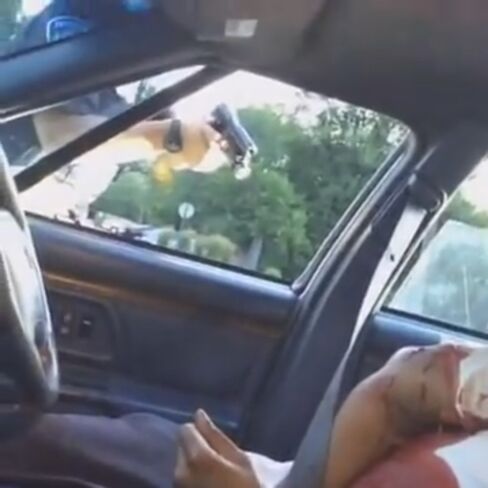
Reynolds’s video of the shooting drew more than 5 million views on Facebook within a day.
 
Source: YouTube
The sentiment suddenly feels quaint. On July 6, during what should have been a routine traffic stop, a police officer in suburban Minneapolis fired multiple shots at Philando Castile, a 32-year-old black man. Seconds later, as he slumped, bloody and gasping for air next to her in the car, Diamond Reynolds, his girlfriend, opened the Facebook app on her smartphone and pressed the Go Live button. She narrated calmly, panning from the gun pointed in her direction to her dying companion, and even kept the broadcast going as she was thrown to the ground, cuffed, and taken into custody. “It’s OK, Mommy,” her 4-year-old daughter could be heard saying in the back seat. “I’m right here with you.”
The next day, Facebook was used by witnesses in Dallas to broadcast live footage of the attack that left five police officers dead and seven others wounded at a Black Lives Matter protest organized in response to the shootings of Castile and Alton Sterling in Baton Rouge, La. In the aftermath of the violence, Facebook Live was inescapable, as public figures took to the platform to process in real time what had happened. “If you are a normal white American, the truth is you don’t understand being black in America, and you instinctively underestimate the level of discrimination and the level of additional risk,” Newt Gingrich told CNN commentator Van Jones in a Facebook Live interview.
Broadcasting video in real time on smartphones isn’t new. Twitter’s Periscope made headlines last year when it enabled users to stream parties from the South by Southwest festival in Austin and unauthorized coverage of the Oscars. But none of the companies that have rolled out live video have Facebook’s scale or technological know-how. With 1.65 billion users—more than half of whom log in every day—footage can quickly command an enormous audience. And live videos are archived, adding even more viewers. Reynolds’s video of Castile’s death drew more than 5 million views on Facebook within a day of the incident and was rebroadcast on several news channels.
The push for live video accelerated in February at an all-hands meeting at Facebook’s campus in Menlo Park, Calif., when Zuckerberg said the format would be central to the company’s future. The new feature represents a technical challenge, taxing cell phone networks and Facebook’s own servers—even Zuckerberg’s own videos have cut out at times. Converting the video right away to work on hundreds of different devices at once is anything but simple. When a user goes live, Facebook must ensure it can process the footage, regardless of the source, and transmit it instantly. “The infrastructure for live-streaming is hard,” Chief Product Officer Chris Cox said in a 2015 interview. “It’s something we’ve been working on for a long time.” Facebook’s custom-manufactured servers, set up around the world to handle any sudden demand for data streaming, helped Reynolds’s stream from the passenger seat of a car go viral almost instantly.
“Facebook is in a position of power. At some point [it] will be asked to shut down a live feed to make sure something doesn’t go viral.” — Jonathan Zittrain, Harvard University
Live-streaming at such a speed and on such a scale raises legal and ethical questions. At least five people this year have been shot while broadcasting with Facebook Live. One, a man in Chicago, was killed. Another man, an apparent sympathizer with Islamic State in Paris, streamed threats after he allegedly murdered a French police commander and his partner. In Milwaukee, two 14-year-olds and a 15-year-old filmed themselves having sex. (Facebook deleted the Paris and Milwaukee videos; the Chicago murder film is still available.)
Videos are routed through a content-moderation system that’s still a work in progress. If any widely viewed live-stream or footage is flagged as inappropriate by a single Facebook user, it’s sent to one of four content-moderating call-center-like operations, in Menlo Park, Austin, Dublin, and Hyderabad, India. Moderators are instructed to interrupt any live-stream that violates Facebook’s community standards, which include bans on threats, self-harm, “dangerous organizations,” bullying, criminal activity, “regulated goods,” nudity, hate speech, and glorified violence. The gatekeepers weigh the public-interest value of a given video against these standards.
“Facebook is in a position of power,” says Jonathan Zittrain, the director of Harvard’s Berkman Klein Center for the Internet and Society. “At some point Facebook will be asked to shut down a live feed to make sure something doesn’t go viral,” he says. The company “needs to be upfront about the decisions it’s making and the pressures under which it’s making them.” The events of the past week have sparked more discussion at Facebook about the company’s role in such situations.
Facebook has said it hopes to use artificial intelligence to help make such split-second judgments, but the technology is a long way off. “You can have filters for certain words, but AI isn’t going to solve what happened in Minnesota,” says Blagica Bottigliero, a vice president at ModSquad, which uses a network of 10,000 contractors worldwide to moderate online content for the NFL and Warner Bros., among others. “You need the judgment of someone looking at the content and bringing in context, and even in those situations they can get it wrong,” Bottigliero says.
The aftermath of the Reynolds video is a case in point in the difficulty of curating newsworthy but violent content. Early on July 7, Facebook took down the video without explanation, then restored it an hour later with an apology and a disclaimer noting its explicit content. This led to news reports citing anonymous sources who claimed the police had deleted the video while Reynolds was in custody. Facebook spokeswoman Andrea Saul sticks with the company’s statement on the issue, that it was a “technical glitch.” A company statement described the incident as “one of the most sensitive situations,” saying: “We’ve learned a lot over the past few months and will continue to make improvements to this experience wherever we can.”
The same day, Zuckerberg addressed the shooting in a Facebook wall post. “The images we’ve seen this week are graphic and heartbreaking,” he wrote. “I hope we never have to see another video like Diamond’s.” In all likelihood, more such video will come, however, and Facebook will again be a news site, whether it wants to be or not.
The bottom line: Facebook has yet to figure out how to moderate the potentially explosive content its 1.65 billion users could live-stream.

Thursday, July 14, 2016

Microsoft's Satya Nadella thinks these four technologies will reshape IT

The Microsoft boss on how firms will automate their IT using Azure and other cloud services, the power of machine learning, and how HoloLens and augmented reality will transform training.

Image result for Microsoft boss

Microsoft CEO Satya Nadella has spelled out the technologies the company believes will reshape enterprise.

Chatbots, machine learning, augmented reality and cloud-based automation will be commonplace within businesses in the near future, Nadella told the company's Worldwide Partner Conference in Toronto today.

During his keynote, Nadella talked about Microsoft's efforts to help businesses incorporate each of these technologies and satisfy what he said was a desire among CEOs "to use digital technology to change their business outcomes".

Augmented reality and Hololens

Microsoft HoloLens is an untethered headset that overlays digital information and images on top of the real world around you.

Nadella described the "mixed reality" offered by HoloLens as a sea-change in personal computing, which would transform training within business.

To demonstrate he brought out Microsoft's general manager for HoloLens Lorraine Bardeen, who showed the audience a demonstration of how Japan Airlines is using the HoloLens to train engineers.

During the demonstration a Japan Airlines engineer showed how HoloLens augmented her vision, placing windows for her email, calendar, web browser, Skype and Power BI dashboard around her, as seen below.

hololens1.png
A Microsoft mock-up of what the Japan Airlines engineer could see using HoloLens.

She then demonstrated how HoloLens could show her a 3D model of a jet engine. She interacted with the model, using gestures and voice commands to resize it, to highlight different components and to trigger animated demonstrations and spoken descriptions detailing what each engine part does.

hololens2.png
The mock-up of how HoloLens displays the 3D model of the jet engine.

Bardeen said the headset is available now to developers and enterprises.

"I would encourage everyone to look at the applicability of this new medium in the context of everyday business applications, because it will really be the most transformative thing," said Nadella.

It should be noted that early versions of the headset had a more limited field of view than is suggested by the images from today's demonstration.

Cloud-based automation

Microsoft wants businesses to use its Azure cloud platform to connect the various collaboration and communications apps, line of business software and professional social networks like LinkedIn, which Microsoft is acquiring.

"What if the software was built in ways that we could connect those disparate worlds," said Nadella, adding he believes Microsoft is "on the cusp" of being able to do so.

By linking cloud data and services, he said Microsoft wants to allow companies to build highly automated business systems.

The keynote saw a demonstration of how a company called Ecolab is using Microsoft's technology to automate its business.

The utilities company uses a Power BI dashboard to view real-time data and analysis covering its site management, retail and operational performance. In the example, Ecolab used the Power BI dashboard to see that a customer called City Power had an issue with a cooling tower.

Using a mix of Azure Insights, Cortana Intelligence and Dynamics 365, an alert was generated and a field technician assigned to fix the problem — based on that engineer's expertise, location and parts available. Each step in the process happened automatically, eliminating the need for manual calls and data entry. That technician could then be tracked using Dynamics 365.

Microsoft also demoed how Dynamics 365 can be configured to automatically perform certain tasks using the automation tool Microsoft Flow, which can link different online services together to trigger actions in response to events. In this instance, Flow was used to trigger a critical email alert and push notification message to certain users, as well as to update a City Power SharePoint list, when a record detailing a critical event was created in Dynamics 365. Ecolab also used the drag and drop app creation tool Microsoft PowerApps to more easily create custom apps for viewing customer information.

"It's no longer about one monolithic suite and its deployment. It's this continuous wiring and rewiring of the digital feedback loop, that's where the power of cloud and the graph of the data in the cloud — underneath all of our applications and tools like Power BI, PowerApps and Flow — come to bear, " said Nadella.

During the keynote, General Electric also announced that its Predix platform for industrial IoT would now be running on Microsoft Azure.

Machine learning

Artificial intelligence is increasingly appealing to businesses, according to Nadella, with firms finding many uses for the 22 "cognitive service" APIs that Microsoft offers.

These APIs allow developers access to various AI-related, Microsoft services — including speech and language recognition and computer vision.

"Every business process application you can conceive of can be transformed," he said.

Nadella gave the example of the fast-food retailer McDonalds, which has been working with Microsoft on an automated speech recognition system that transcribes people's orders at drive-thrus.

In a pre-recorded demonstration the system appeared to be accurately transcribing the speech of a person placing an order. However, the system was not shown in a live demo.

microsoft-cognitive-services.png
A demo of the McDonalds system for automatically transcribing food orders.

Nadella said that the accuracy of the system stemmed from how tunable Microsoft's cognitive services are. For instance, in the case of McDonalds, the accuracy of the transcription had been improved by tuning the system to screen out the typical ambient noise at drive-thrus and by teaching it common phrases used when placing food orders.

McDonalds is looking to use the system to push orders directly into its point-of-sale systems, he said, transforming the spoken order into a JSON object the system can parse.

"That type of integration, of cognitive capability into business process, is what we are enabling today," he said.

Bots

Microsoft is also betting that most of us will interact with computers using chatbots in future.

These bots will be able to understand simple typed or spoken questions and commands and respond appropriately, at least that's the ambition.

Rather than manually launching applications, Nadella talks of information and services being intelligent triggered by these bots, based on our conversations.

Banks and other businesses are already using the Microsoft Bot Framework to build bots for Skype, Facebook, Slack and "anywhere where people are communicating", he said.

He believes that Microsoft's virtual assistant Cortana will take on this role of managing services and information for computer users.

Nadella showed an example where Cortana highlighted an upcoming meeting and the people in the meeting, pulling information from their LinkedIn profiles. Follow up questions to Cortana saw the assistant pull in the sales pipeline for the company from the CRM system and make recommendations on certain actions to take during the meeting, for example who to add to which projects based on their skills and experience.

"That's a new way of how computing is accessed," said Nadella, adding "over time [it] will fundamentally revolutionize how computing is experienced by everybody."