Tuesday, July 19, 2016

ARM's $31 billion takeover shows that information is king

SoftBank is getting a bargain
Image result for ARM Holdings
ARM Holdings, a chip design firm that doesn’t manufacture or sell any chips, has just been bought by SoftBank for a cool $31.4 billion. That’s four times as much as Microsoft paid for Nokia, close to three times Google’s expenditure on Motorola, and an order of magnitude more than Palm cost HP. We think of these other companies as the authors of the mobile world we’re living in, but it’s ARM’s invisible contribution that has proven more influential — and now a lot more valuable — than all of them.

The smartphone revolution of this century might as well be called the ARM takeover. Practically every single phone, tablet, and smartwatch out in the world today runs on a processor using the ARM architecture — which means licensing ARM’s designs and paying royalties for every chip sold. Yes, that includes iPhones, Galaxys, BlackBerrys, Droids, and Lumias: all but the most loyal of Intel acolytes are manufacturing ARM-powered mobile devices. ARM’s portfolio extends beyond mobile processors to include graphics, wireless, and server chips along with physical design blueprints and software development tools. Simply put, if you want to build a mobile device of any kind, you’ll have to deal with ARM.

ARM IS AN INTELLECTUAL PROPERTY POWERHOUSE

ARM’s product is information. The company spends its time and money on R&D, which it converts into successive generations of new mobile processor core and system designs. Its hardware partners would love to be able to build everything themselves, but ARM’s depth and breadth of expertise is such that it’s more efficient to license rather than compete with its technology. With more than 4,500 granted or pending patents, ARM is an intellectual property powerhouse — like a patent troll that isn’t actually trolling, it just develops smart production methods and designs and sells them.

An oft-cited aphorism from Tom Goodwin last year identified one of the prevailing trends of modern tech:

"Uber, the world’s largest taxi company, owns no vehicles. Facebook, the world’s most popular media owner, creates no content. Alibaba, the most valuable retailer, has no inventory. And Airbnb, the world’s largest accommodation provider, owns no real estate. Something interesting is happening."

The "something interesting" is happening behind the scenes of the tech world too. ARM is another of these prospering companies whose profits keep improving even in the absence of any tangible, physical assets. It isn’t chasing consumers directly, but it’s just as much a trader in information as Facebook, Uber, and Airbnb are. Consumers recompense ARM via the intermediary of a hardware-manufacturing partner, but the core mechanics are still the same: obtain valuable information, secure your control over it, sell it to a willing purchaser, and profit.

ARM's Holdings
It’s a simple formula that should be extremely familiar by now. Data and software might have high initial acquisition or production costs, but once you have them, the marginal cost of producing another unit to sell or license is zero. ARM has carved out its niche by continuously being ahead of the competition, nullifying Intel’s Sisyphean efforts to break through into mobile, and developing a wide network of satisfied licensees.
The headline reason for SoftBank’s acquisition of ARM today is the latter company’s instrumental role in developing the future Internet of Things. The pair have even set up a website dedicated to the deal, where they explain their rationale and talk up plans for world domination that’s even greater than the 90 billion ARM chips already out there. But the IoT future isn’t here yet, and a seasoned investor like SoftBank CEO Masayoshi Son doesn’t spend $31 billion purely on potential. He sees that ARM is an already profitable company with comparatively negligible expenses, he recognizes the massive discountthat Brexit’s impact on the British pound has created, and he knows ARM’s influence is far greater than its size. It just makes good business sense, especially at a time when debt is cheap to sustain and cash is more of a burden than an asset.
THE INFORMATION AGE IS DEFINED BY COMPANIES LIKE ARM, WHOSE ASSETS ARE INTANGIBLE
To casual observers, the idea of a company with no brand recognition — anonymous to all but the geeky spec sheet explorers — meriting an 11-figure price will seem absurd. But just like the more consumer-facing acquisitions of WhatsApp by Facebook and LinkedIn by Microsoft, this is a big investment into the information economy.
As much as hardware companies like Apple and Samsung might dominate news coverage and people’s wish lists, it’s the software and service providers that load those devices up and make them truly desirable. In ARM’s case, its information provides the blueprint and architecture atop which everything is built. Hardware manufacturers may come and go, but the one essential and irreplaceable aspect of modern mobile computing is ARM’s portfolio of intellectual property. That’s where the value is.

Monday, July 18, 2016

Is Facebook Ready to Be the World’s Live News Network? (BW)

The social network has yet to figure out how to moderate the potentially explosive content its 1.65 billion users could live-stream.
Until recently, the big news in the world of news was that Facebook was retreating from journalism. After an unexpected dip in the personal sharing that is its core business, plus a mini-scandal involving allegations of political bias in how it displayed content from conservative websites, Facebook said it was updating its algorithm to prioritize wedding announcements and baby photos over postings by media companies. “Friends and family come first,” the company said in a June 29 blog post.
And when Chief Executive Officer Mark Zuckerberg announced the Facebook Live video function, he presented it as a platform for life’s small trials and triumphs. “You can feel like you’re really there with your friends,” he said on April 6, when the service launched. Among the videos he praised: a young man’s haircut as it happened, a woman skiing downhill with her kids, and a zoo camera trained on some baby birds. “Everyone is tuned in, watching these cute bald eagles, wondering what’s going to happen,” he said, with a wide grin. “It’s kind of a new thing.”
Reynolds’s video of the shooting drew more than 5 million views on Facebook within a day.
 
Source: YouTube
The sentiment suddenly feels quaint. On July 6, during what should have been a routine traffic stop, a police officer in suburban Minneapolis fired multiple shots at Philando Castile, a 32-year-old black man. Seconds later, as he slumped, bloody and gasping for air next to her in the car, Diamond Reynolds, his girlfriend, opened the Facebook app on her smartphone and pressed the Go Live button. She narrated calmly, panning from the gun pointed in her direction to her dying companion, and even kept the broadcast going as she was thrown to the ground, cuffed, and taken into custody. “It’s OK, Mommy,” her 4-year-old daughter could be heard saying in the back seat. “I’m right here with you.”
The next day, Facebook was used by witnesses in Dallas to broadcast live footage of the attack that left five police officers dead and seven others wounded at a Black Lives Matter protest organized in response to the shootings of Castile and Alton Sterling in Baton Rouge, La. In the aftermath of the violence, Facebook Live was inescapable, as public figures took to the platform to process in real time what had happened. “If you are a normal white American, the truth is you don’t understand being black in America, and you instinctively underestimate the level of discrimination and the level of additional risk,” Newt Gingrich told CNN commentator Van Jones in a Facebook Live interview.
Broadcasting video in real time on smartphones isn’t new. Twitter’s Periscope made headlines last year when it enabled users to stream parties from the South by Southwest festival in Austin and unauthorized coverage of the Oscars. But none of the companies that have rolled out live video have Facebook’s scale or technological know-how. With 1.65 billion users—more than half of whom log in every day—footage can quickly command an enormous audience. And live videos are archived, adding even more viewers. Reynolds’s video of Castile’s death drew more than 5 million views on Facebook within a day of the incident and was rebroadcast on several news channels.
The push for live video accelerated in February at an all-hands meeting at Facebook’s campus in Menlo Park, Calif., when Zuckerberg said the format would be central to the company’s future. The new feature represents a technical challenge, taxing cell phone networks and Facebook’s own servers—even Zuckerberg’s own videos have cut out at times. Converting the video right away to work on hundreds of different devices at once is anything but simple. When a user goes live, Facebook must ensure it can process the footage, regardless of the source, and transmit it instantly. “The infrastructure for live-streaming is hard,” Chief Product Officer Chris Cox said in a 2015 interview. “It’s something we’ve been working on for a long time.” Facebook’s custom-manufactured servers, set up around the world to handle any sudden demand for data streaming, helped Reynolds’s stream from the passenger seat of a car go viral almost instantly.
“Facebook is in a position of power. At some point [it] will be asked to shut down a live feed to make sure something doesn’t go viral.” — Jonathan Zittrain, Harvard University
Live-streaming at such a speed and on such a scale raises legal and ethical questions. At least five people this year have been shot while broadcasting with Facebook Live. One, a man in Chicago, was killed. Another man, an apparent sympathizer with Islamic State in Paris, streamed threats after he allegedly murdered a French police commander and his partner. In Milwaukee, two 14-year-olds and a 15-year-old filmed themselves having sex. (Facebook deleted the Paris and Milwaukee videos; the Chicago murder film is still available.)
Videos are routed through a content-moderation system that’s still a work in progress. If any widely viewed live-stream or footage is flagged as inappropriate by a single Facebook user, it’s sent to one of four content-moderating call-center-like operations, in Menlo Park, Austin, Dublin, and Hyderabad, India. Moderators are instructed to interrupt any live-stream that violates Facebook’s community standards, which include bans on threats, self-harm, “dangerous organizations,” bullying, criminal activity, “regulated goods,” nudity, hate speech, and glorified violence. The gatekeepers weigh the public-interest value of a given video against these standards.
“Facebook is in a position of power,” says Jonathan Zittrain, the director of Harvard’s Berkman Klein Center for the Internet and Society. “At some point Facebook will be asked to shut down a live feed to make sure something doesn’t go viral,” he says. The company “needs to be upfront about the decisions it’s making and the pressures under which it’s making them.” The events of the past week have sparked more discussion at Facebook about the company’s role in such situations.
Facebook has said it hopes to use artificial intelligence to help make such split-second judgments, but the technology is a long way off. “You can have filters for certain words, but AI isn’t going to solve what happened in Minnesota,” says Blagica Bottigliero, a vice president at ModSquad, which uses a network of 10,000 contractors worldwide to moderate online content for the NFL and Warner Bros., among others. “You need the judgment of someone looking at the content and bringing in context, and even in those situations they can get it wrong,” Bottigliero says.
The aftermath of the Reynolds video is a case in point in the difficulty of curating newsworthy but violent content. Early on July 7, Facebook took down the video without explanation, then restored it an hour later with an apology and a disclaimer noting its explicit content. This led to news reports citing anonymous sources who claimed the police had deleted the video while Reynolds was in custody. Facebook spokeswoman Andrea Saul sticks with the company’s statement on the issue, that it was a “technical glitch.” A company statement described the incident as “one of the most sensitive situations,” saying: “We’ve learned a lot over the past few months and will continue to make improvements to this experience wherever we can.”
The same day, Zuckerberg addressed the shooting in a Facebook wall post. “The images we’ve seen this week are graphic and heartbreaking,” he wrote. “I hope we never have to see another video like Diamond’s.” In all likelihood, more such video will come, however, and Facebook will again be a news site, whether it wants to be or not.
The bottom line: Facebook has yet to figure out how to moderate the potentially explosive content its 1.65 billion users could live-stream.

Thursday, July 14, 2016

Microsoft's Satya Nadella thinks these four technologies will reshape IT

The Microsoft boss on how firms will automate their IT using Azure and other cloud services, the power of machine learning, and how HoloLens and augmented reality will transform training.

Image result for Microsoft boss

Microsoft CEO Satya Nadella has spelled out the technologies the company believes will reshape enterprise.

Chatbots, machine learning, augmented reality and cloud-based automation will be commonplace within businesses in the near future, Nadella told the company's Worldwide Partner Conference in Toronto today.

During his keynote, Nadella talked about Microsoft's efforts to help businesses incorporate each of these technologies and satisfy what he said was a desire among CEOs "to use digital technology to change their business outcomes".

Augmented reality and Hololens

Microsoft HoloLens is an untethered headset that overlays digital information and images on top of the real world around you.

Nadella described the "mixed reality" offered by HoloLens as a sea-change in personal computing, which would transform training within business.

To demonstrate he brought out Microsoft's general manager for HoloLens Lorraine Bardeen, who showed the audience a demonstration of how Japan Airlines is using the HoloLens to train engineers.

During the demonstration a Japan Airlines engineer showed how HoloLens augmented her vision, placing windows for her email, calendar, web browser, Skype and Power BI dashboard around her, as seen below.

hololens1.png
A Microsoft mock-up of what the Japan Airlines engineer could see using HoloLens.

She then demonstrated how HoloLens could show her a 3D model of a jet engine. She interacted with the model, using gestures and voice commands to resize it, to highlight different components and to trigger animated demonstrations and spoken descriptions detailing what each engine part does.

hololens2.png
The mock-up of how HoloLens displays the 3D model of the jet engine.

Bardeen said the headset is available now to developers and enterprises.

"I would encourage everyone to look at the applicability of this new medium in the context of everyday business applications, because it will really be the most transformative thing," said Nadella.

It should be noted that early versions of the headset had a more limited field of view than is suggested by the images from today's demonstration.

Cloud-based automation

Microsoft wants businesses to use its Azure cloud platform to connect the various collaboration and communications apps, line of business software and professional social networks like LinkedIn, which Microsoft is acquiring.

"What if the software was built in ways that we could connect those disparate worlds," said Nadella, adding he believes Microsoft is "on the cusp" of being able to do so.

By linking cloud data and services, he said Microsoft wants to allow companies to build highly automated business systems.

The keynote saw a demonstration of how a company called Ecolab is using Microsoft's technology to automate its business.

The utilities company uses a Power BI dashboard to view real-time data and analysis covering its site management, retail and operational performance. In the example, Ecolab used the Power BI dashboard to see that a customer called City Power had an issue with a cooling tower.

Using a mix of Azure Insights, Cortana Intelligence and Dynamics 365, an alert was generated and a field technician assigned to fix the problem — based on that engineer's expertise, location and parts available. Each step in the process happened automatically, eliminating the need for manual calls and data entry. That technician could then be tracked using Dynamics 365.

Microsoft also demoed how Dynamics 365 can be configured to automatically perform certain tasks using the automation tool Microsoft Flow, which can link different online services together to trigger actions in response to events. In this instance, Flow was used to trigger a critical email alert and push notification message to certain users, as well as to update a City Power SharePoint list, when a record detailing a critical event was created in Dynamics 365. Ecolab also used the drag and drop app creation tool Microsoft PowerApps to more easily create custom apps for viewing customer information.

"It's no longer about one monolithic suite and its deployment. It's this continuous wiring and rewiring of the digital feedback loop, that's where the power of cloud and the graph of the data in the cloud — underneath all of our applications and tools like Power BI, PowerApps and Flow — come to bear, " said Nadella.

During the keynote, General Electric also announced that its Predix platform for industrial IoT would now be running on Microsoft Azure.

Machine learning

Artificial intelligence is increasingly appealing to businesses, according to Nadella, with firms finding many uses for the 22 "cognitive service" APIs that Microsoft offers.

These APIs allow developers access to various AI-related, Microsoft services — including speech and language recognition and computer vision.

"Every business process application you can conceive of can be transformed," he said.

Nadella gave the example of the fast-food retailer McDonalds, which has been working with Microsoft on an automated speech recognition system that transcribes people's orders at drive-thrus.

In a pre-recorded demonstration the system appeared to be accurately transcribing the speech of a person placing an order. However, the system was not shown in a live demo.

microsoft-cognitive-services.png
A demo of the McDonalds system for automatically transcribing food orders.

Nadella said that the accuracy of the system stemmed from how tunable Microsoft's cognitive services are. For instance, in the case of McDonalds, the accuracy of the transcription had been improved by tuning the system to screen out the typical ambient noise at drive-thrus and by teaching it common phrases used when placing food orders.

McDonalds is looking to use the system to push orders directly into its point-of-sale systems, he said, transforming the spoken order into a JSON object the system can parse.

"That type of integration, of cognitive capability into business process, is what we are enabling today," he said.

Bots

Microsoft is also betting that most of us will interact with computers using chatbots in future.

These bots will be able to understand simple typed or spoken questions and commands and respond appropriately, at least that's the ambition.

Rather than manually launching applications, Nadella talks of information and services being intelligent triggered by these bots, based on our conversations.

Banks and other businesses are already using the Microsoft Bot Framework to build bots for Skype, Facebook, Slack and "anywhere where people are communicating", he said.

He believes that Microsoft's virtual assistant Cortana will take on this role of managing services and information for computer users.

Nadella showed an example where Cortana highlighted an upcoming meeting and the people in the meeting, pulling information from their LinkedIn profiles. Follow up questions to Cortana saw the assistant pull in the sales pipeline for the company from the CRM system and make recommendations on certain actions to take during the meeting, for example who to add to which projects based on their skills and experience.

"That's a new way of how computing is accessed," said Nadella, adding "over time [it] will fundamentally revolutionize how computing is experienced by everybody."

Wednesday, July 13, 2016

Cool Desks and Workspaces...


The BendDesk has a multi-touch screen that lets you use vertical and horizontal surfaces to virtually organize your work.
With a reclinable chair, a Bose sound system, and the ability to add up to five monitors, the Emperor 151 LX creates an immersive work or gaming experience. 
Why not work on a 600-gallon fish tank?
Gravitonous is one of the most ergonomic desks in the world, which means you can comfortably work or game as long as you want.
Imagination and talent ... to have a cool environment
 A liquid-cooled computer desk
If you love cars...

Tuesday, July 12, 2016

Facebook Accused in $1 Billion Suit of Being Hamas Tool


  • Why the $1B Lawsuit Against Facebook Doesn't Have Merit
  • Damages sought for families of 5 American victims of attacks
  • Facebook says it doesn’t comment to press on legal proceedings

Lawyers filed a $1 billion lawsuit against Facebook Inc., alleging it allowed the Palestinian militant Hamas group to use the platform to plot attacks that killed four Americans and wounded one in Israel, the West Bank and Jerusalem.

“Facebook has knowingly provided material support and resources to Hamas in the form of Facebook’s online social network platform and communication services,” making it liable for the violence against the five Americans, according to the lawsuit sent to Bloomberg by the office of the Israeli lawyer on the case, Nitsana Darshan-Leitner.

“Simply put, Hamas uses Facebook as a tool for engaging in terrorism,” it said.

Image result for Facebook Accused in $1 Billion Suit of Being Hamas Tool

Hamas is considered a terrorist organization by the U.S., European Union and Israel. The suit said the group used Facebook to share operational and tactical information with members and followers, posting notices of upcoming demonstrations, road closures, Israeli military actions and instructions to operatives to carry out the attacks.

Mushir al-Masri, a senior Hamas leader, said by phone that “suing Facebook clearly shows the American policy of fighting freedom of the press and expression” and is evidence of U.S. prejudice against the group and “its just cause.”

Facebook wants “people to feel safe when using Facebook. There is no place for content encouraging violence, direct threats, terrorism or hate speech on Facebook,” the company said in a response to a request for comment on the case. “We have a set of Community Standards to help people understand what is allowed on Facebook, and we urge people to use our reporting tools if they find content that they believe violates our standards so we can investigate and take swift action.”

In March Facebook took down a page promoting a new Palestinian uprising against Israel because it made “direct calls for violence,” in violation of company polices.

Gabriel Weimann, an expert on terrorism on the internet at Haifa University, said technology would be more effective than litigation in discouraging the use of social media for violent purposes. The focus should be on developing faster ways to detect problematic messages so they can be blocked immediately before they go viral, he said.

“Facebook isn’t the only platform,” he said. “There are plenty of others. What will you do? Sue them all?”

The suit was submitted to the U.S. District Court for the Southern District of New York on July 10. Plaintiffs include the families of Yaakov Naftali Fraenkel, a 16-year-old abducted and murdered in June 2014 after hitching a ride in the West Bank, and 3-year-old Chaya Braun, whose stroller was struck intentionally by a Palestinian driver in October 2014 at a train station in Jerusalem.

In February 2015, a jury at the same court concluded that the Palestinian Authority and Palestine Liberation Organization aided in six attacks on Americans in Israel more than a decade ago, and ordered them to pay $218.5 million to the victims and their families. The damages were tripled under a U.S. anti-terrorism law.

The Palestinian bodies claimed they weren’t responsible for the unapproved acts of low-level employees who participated in the attacks.

Monday, July 11, 2016

Use of police robot to kill...

Dallas shooting suspect believed to be first in US history
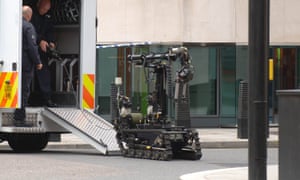
Bomb-disposal robots such as the one seen here have been used by the military as a weapon, according to Peter Singer of the New America Foundation, but never before by police.
Police’s lethal use of bomb-disposal robot in Thursday’s ambush worries legal experts who say it creates gray area in use of deadly force by law enforcement

For what experts are calling the first time in history, US police have used a robot in a show of lethal force. Early Friday morning, Dallas police used a bomb-disposal robot with an explosive device on its manipulator arm to kill a suspect after five police officers were murdered and seven others wounded.

“We saw no other option but to use our bomb robot and place a device on its extension for it to detonate where the suspect was,” Dallas police chief David Brown told reporters.

Peter Singer, a strategist and senior fellow at the New America Foundation who writes about the technology of warfare, said he believed this was a first. “There may be some story that comes along, but I’d think I’d have heard of it,” he said.

Others concurred. “As far as I know, it appears to be the first intentional use of a lethally armed robot by the police in the United States,” said Elizabeth Joh, law professor at the University of California at Davis.

This is not the first time a robot designed with other functions in mind has been used as a weapon, but this kind of repurposing has until now been limited to the military. Singer said that in the early 2000s, a solider he interviewed repurposed a surveillance robot called a Marcbot with a bomb. These robots aren’t autonomous, Singer emphasized – the Marcbot “is like a toy truck with a sensor and camera mount they’d use to drive up to a checkpoint”. But this soldier had improvised: “They duct-taped an explosive and you can figure out the rest. You can see the parallels here.”

Singer also said that he was “in no way, shape or form condemning” the DPD’s decision. Brown said the decision protected police officers on a night when their lives were at greater risk than usual. “Other options would have exposed our officers in grave danger,” Singer said.

Joh said she was worried that the decision by police to use robots to end lives had been arrived at far too casually. “Lethally armed police robots raise all sorts of new legal, ethical, and technical questions we haven’t decided upon in any systematic way,” she said. “Under federal constitutional law, excessive-force claims against the police are governed by the fourth amendment. But we typically examine deadly force by the police in terms of an immediate threat to the officer or others. It’s not clear how we should apply that if the threat is to a robot – and the police may be far away.” That, Joh added, is only one condition for the use of lethal force. “In other words, I don’t think we have a framework for deciding objectively reasonable robotic force. And we need to develop regulations and policies now, because this surely won’t be the last instance we see police robots.”

The “bomb robot” used is assumed to be the DPD’s bomb-disposal unit, a wheeled, remote-controlled (as opposed to autonomous) robot with a manipulator arm on top. “When there’s a suspected explosive device, a suspected IED, you have this device with a robotic arm and a gripper on it,” Singer explained. “You might use the device to open up a bag and see if there’s a bomb in it. You might use the gripper to disassemble the device in the classic Hollywood movie cut-the-wire way; you might shoot high-pressure water into it, and you might do a controlled detonation.”

That, Singer said, is why the department had explosives handy – sometimes the preferred way to deal with a bomb is to evacuate the area around it and use another bomb to blow it up.

Similar robots were used in the DPD’s showdown with a gunman who assaulted the department’s headquarters with guns and bombs almost exactly a year ago.

On the military side, such improvisations are both the solution and, increasingly, the problem. “We’ve seen insurgents improvise,” Singer said. “Literally this week, the Joint Improvised-Threat Defeat Agency [an agency within the Department of Defense whose purpose is to develop better ways for the military to respond to IEDs] got a $20m grant to defeat drone IEDs, not for missiles but for small commercial drones that you and I could buy, which are used by Isis for both surveillance and for explosive delivery.

“Technology is a tool,” Singer said. “Tools are used the way they’re designed, and then people improvise and find new uses for them.”