Thursday, May 19, 2016

Google Embeds AI in New Products to Make Search Ubiquitous

New digital personal assistant part of broader AI strategy
Assistant to appear in Allo messaging app, then Home device

Google is turning to artificial intelligence to make sure people keep using its search engine, even if they’re not spending as much time on the Web and personal computers

Google became one of the world’s most valuable companies by making a search engine that sucks in billions of queries people type into web browsers on PCs and phones. Google sells ads based those indications of intent and desire. But that search advertising money machine is at risk as computing evolves and gives people new ways to find what they want -- and new avenues for competing companies to satisfy those wants.

The new products unveiled Wednesday -- and future ones using the same Google AI technology -- give the company a chance to keep its search engine relevant in an era of new, connected devices.

Conversational interface

With the future of search -- and intent-based advertising -- up for grabs again, AI has become a big strategic area of investment for many technology companies. The bet is that whoever makes the most engaging and useful digital personal assistant, also known as the conversational interface, will control the layer between a person and their digital life, and collect the most revenue and profit from being that privileged broker.

Google has been working on artificial intelligence -- technology that lets computers teach themselves about the world -- for more than 15 years. The company hopes this expertise can help it build conversational computing products that beat the competition. 

"It’s absolutely strategic," said Scott Huffman, a vice president of engineering for search. "If you think about this simple idea of having a conversation, that is the interface that all the people around you have."

Google hopes that if it makes it easier for people to access its services, they’ll use them more. That’s a pattern it has seen with other technology initiatives. "Every time we’ve had an improvement in voice recognition we see a corresponding jump in usage," Huffman said.

Conversational computing is a crowded field. Amazon’s Echo, which has been a bestseller for the company, lets people use their voice rather than type to search for things and order them from Amazon’s online store and play music through Amazon-owned services, cutting out Google. Microsoft Corp.’s Cortana AI assistant embedded in Windows 10 lets people ask questions that the company answers via its Bing search engine. Facebook Inc.’s digital assistant, M, uses some AI to let people get answers to questions and perform actions such as ordering flowers, and its recently unveiled chatbot platform gives companies a way to chat directly with consumers, no Googling required.

Allo Google

Over time, Google said it will develop other products and services using the same digital assistant, which will stay with people across devices, and remember their habits, Huffman said. That will let Google’s search and other services follow people from smartphones and smart watches into their car and homes. Google plans to add more AI capabilities to its assistant, some of which won’t necessarily appear in its main search engine, Huffman said.
The company’s Allo messaging app will come out this summer. It will suggest responses to messages by reading and understanding people’s text conversations. A contact named "@google" can be summoned by users to provide AI-powered services, like finding restaurants and booking tables, or searching for movies.

The AI in Allo is based on technology already deployed in Google’s Inbox program, which reads through e-mails and suggests appropriate replies. It also understands images sent in text messages, using its AI to look at what is in the picture and suggest its own comments.
The more people use Allo the better the AI will get. The system works by converting words and images into sequences of numbers explicable to Google’s machine intelligence, letting it develop intuition so it can guess the word "dog" is semantically similar to puppy, or that the appropriate response to a picture of someone skydiving is "brave."

In a recent demo, Erik Kay, a Google director of engineering for communications products, took a photo of colleague Amit Fulay, who posed with an exaggerated grin. Kay texted the photo to Amit using Allo, and on Amit’s phone the AI studied the photo, noticed the grin and came up with the response "sunny smile :-)". These kinds of automated responses are meant to give people a more satisfying conversation, but has the additional benefit of generating more data for Google to use to further develop its AI.

Google Home

After Allo, the company plans to release the Google Home device that people can speak to. The gadget will play music, communicate with other Google devices, and answer questions using Google’s AI assistant and its search engine, along with managing other Google products like Calendar and Gmail. People will summon it by using the same call out -- "OK, Google" -- that is used in other existing Google mobile apps. "Hey, Google" will also work.
"We don’t necessarily have to be first every time, that’s not actually our goal, but we want to be the most scalable solution," said Rishi Chandra, a vice president of product management for Google, noting the product is "not an assistant that does three things but it can really do anything."

Over time, Google said its AI will gain new capabilities. The company plans to give it a more flexible memory, so when people have a conversation where a friend references their home address, it will learn to associate that location with them. A technology called “Expander” will help the technology work in multiple languages, with insights gleaned from AI deployed in one language feeding the intelligence of the software in another tongue.
But it will take time for the AI to be able to anticipate and respond to every request, said Huffman. "It’s nice job security for us because it’s going to take it a while to let it do anything people want to do."
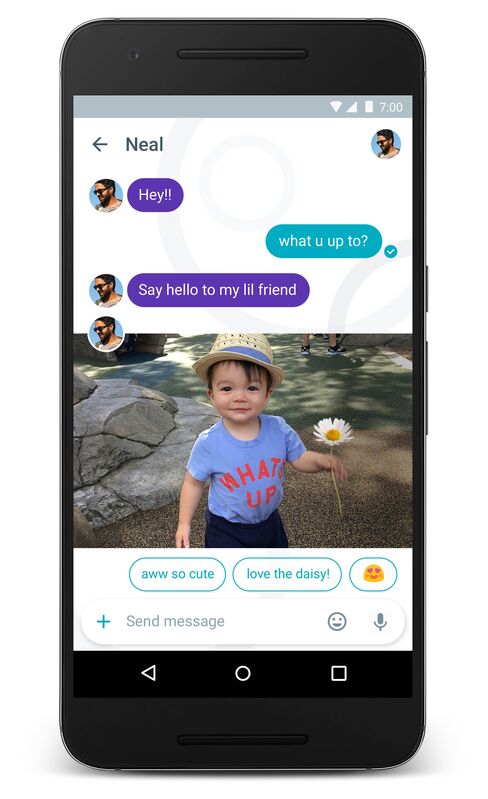
Google Allo can study the photo and suggests possible responses. Source: Google
Google Allo can study the photo and suggests possible responses. 

The Alphabet Inc. division unveiled a new mobile messaging application Wednesday called Allo containing a digital personal assistant, based on AI technology that powers other Google services like Inbox.

At its I/O developer conference near its Silicon Valley headquarters, the company also showed off a voice-based search device called Google Home that uses the same assistant technology to answer questions when people are in their houses, a potentially potent rival to Amazon.com Inc.’s popular Echo gadget.

Google Chief Executive Officer Sundar Pichai said the goal is to develop an “on-going two-way dialog with Google” and build billions of people their own “individual Google.” The CEO sees the Google digital assistant as an “ambient experience that extends across devices.”

Wednesday, May 18, 2016

Microsoft makes it easier for firms to keep running Windows 7


The technology giant releases a bundle of updates for the seven-year-old operating system in the latest move designed to appeal to businesses in no rush to move to Windows 10.

Microsoft has taken another decision that should make it easier for businesses to continue running Windows 7.

The technology giant yesterday announced the release of the Windows 7 SP1 convenience rollup, a collection of security and other updates for the seven-year-old operating system. The release includes core Windows fixes, security fixes and hot fixes that have been issued since Service Pack 1 was released in 2011 and is designed to simplify the updating process.

Microsoft's decision to release the bundle is a departure from the firm's stance earlier this year, when it said it had no news on the promised convenience rollup of fixes for Windows 7, stressing instead "the success our customers are experiencing upgrading to Windows 10".

The release follows another recent choice by Microsoft to dial back pressure on businesses to move to Windows 10. At the beginning of the year, Microsoft announced it would phase out support for Windows 7 and 8 on new PC hardware. The move seemed designed to encourage businesses not to downgrade new Windows 10 machines to an earlier OS, as has been common in the past in order to standardize corporate hardware. However, Microsoft later watered down the plans, pushing back the point at which it will end full extended support for Windows 7 and 8.1 machines running on Intel's Skylake CPUs.

Richard Edwards, principal analyst for Enterprise ICT at Ovum, said Microsoft's recent decisions are an acknowledgement of how many businesses still run Windows 7 and how long it will likely take them to switch.

"Most organizations are still in the early planning stage when it comes to Windows 10. This means that most of the PCs running Windows 10 today are in the consumer segment of the market, and thus Windows 7 is probably running on 80 percent-plus business Windows PCs," he said.

Inside enterprises, Windows 7 is "going to be around for many years to come," he said. "Microsoft has to find ways to please and delight these enterprise customers, and easing the burden on IT departments is one way to do this."

While Edwards believes the release of the Anniversary Edition update to Windows 10 will drive upgrades by early adopters, he predicted that mass adoption is still some way off, forecasting that the bulk of firms will migrate from mid-2017 through to 2020.

"Organizations will only upgrade to Windows 10 if they have a clear insight into its business value," said Edwards, adding that key business features such as Enterprise Data Protection were still not in place.

Microsoft's focus on driving customers to Windows 10 has earned it criticism from small businesses, which recently complained about the decision to push the aggressive Get Windows icons and pop-ups to domain-joined PCs.

Analyst house Gartner had predicted that adoption of Windows 10 by business would be "significantly more rapid" than that of Windows 7 but this year was more cautious, claiming that flat IT budgets are pushing the start of enterprise migrations back to 2017.

"It's to do with current budget restrictions as much as anything. They [budgets] are not being made available," said Gartner research director Ranjit Antwal at the time.

There is little third-party data on the rate of adoption of Windows 10 by business, although Microsoft claims enterprises are switching more rapidly than they did to Windows 7.


Tuesday, May 17, 2016

Nation's Fastest-Growing Job Only for Those Who Like to Get High


  • Demand for wind turbine technicians outpacing health and tech
  • Companies competing to hire students before they graduate

Sean Fritzler snapped his 13-pound climbing harness onto a metal cable and clambered 260 rungs up four ladders to the top of a wind turbine as tall as the observation deck on the Statue of Liberty’s crown.

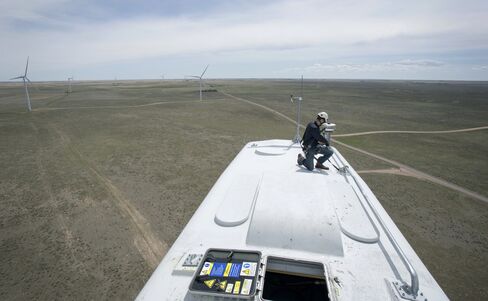
Fritzler reveled in the lofty solitude afforded by the nation’s fastest-growing occupation as he popped open the nacelle hatch. The 15-by-30-foot space was crammed with equipment that makes electricity from wind captured by blades that sweep a vertical area as long as a soccer field. He vaulted up top, clicked an industrial-sized carabiner to a pipe, and stood to take in the 360-degree view. Below, black cows looked like ants.

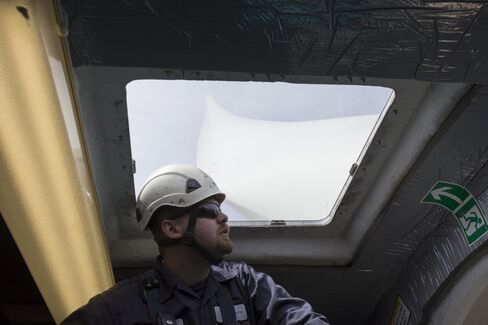
Sean Fritzler looks out of a nacelle.
Sean Fritzler looks out of a nacelle
"My office is 300 feet in the air," said Fritzler, 25, one of five GE Renewable Energy technicians who service 56 turbines at a wind farm on the desolate eastern Colorado prairie. "Everything about this job is interesting."

Demand and intense competition for mechanical daredevils like Fritzler are accelerating as states eschew fossil fuels for renewable energy. Wind-turbine service technicians, who must work at extreme heights during temperamental weather, occupy a job category projected to expand more than any other through 2024, outpacing health care and technology, according to the U.S. Bureau of Labor Statistics.

Congress ensured wind would remain the nation’s quickest-growing source of electricity when it approved a five-year extension of tax credits for the industry in December. States are also fueling the gains; Hawaii plans to generate all its energy from renewable sources by 2045, and California and New York plan on 50 percent by 2030. More than half the wind industry’s capacity is associated with state mandates, most of which have been enacted since 2000, according to an April study by Lawrence Berkeley National Laboratory, part of the U.S. Department of Energy.

"These policies send signals to the wind industry that it’s worth making significant investments," said Warren Leon, executive director of Montpelier, Vermont-based Clean Energy States Alliance, which represents agencies in 16 states from Alaska to New Hampshire. "States see renewables as an area for increased jobs."

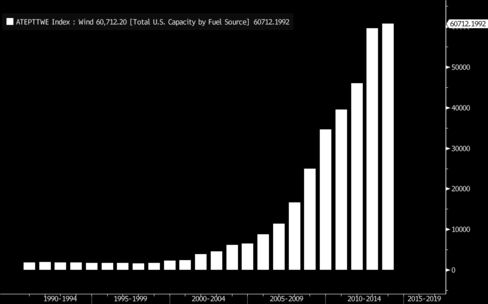
U.S. Wind Capacity
U.S. Wind Capacity

Colorado Governor John Hickenlooper in April called harnessing energy from renewable sources one of his highest priorities. Wind provided 19 percent of the power Xcel Energy Inc. sent to Colorado customers in 2015. Xcel, and providers in Texas and Iowa, drew as much as two thirds of their power at any one time from the country’s 49,000-turbine fleet last year.

More is coming. Construction is under way on 81 projects in 25 states. A record 74,512 megawatts of wind energy, enough to power 20 million average homes, is online as of the end of the first quarter.

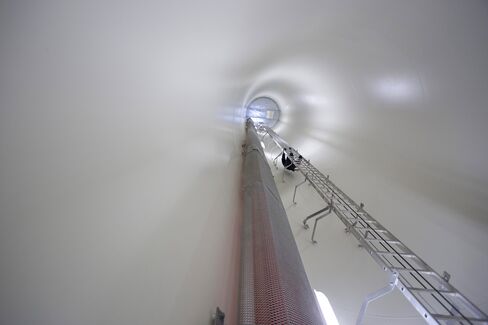
A GE technician climbs up a section of a turbine at the Colorado Highlands Wind Farm in Fleming.
Companies are competing fiercely to hire technicians to keep the power coming. Most are snapped up before they even collect a diploma. Five firms recently approached Andrew Swapp, the director of wind energy technology training at Mesalands Community College in Tucumcari, New Mexico, to court the 27 students in the class of 2016.

"This is an unprecedented number of people asking for our graduates," Swapp said.
Roughnecks Return

Some Mesalands students are former oil and gas industry workers who were among 87,000 handed pink slips in 2015 amid stagnant crude prices. The utilities sector, including the wind and solar industries, hired the second-highest share of out of work roughnecks after the oil and mining industry in 2014, according to the U.S. Census Bureau.

Turbine service technicians took home a $53,030 annual mean wage, more than their counterparts on oil derricks, who earned $52,680, according to a May 2015 report from the Bureau of Labor Statistics.

Federal economists project the demand for wind turbine service technicians to grow 108 percent by 2024 -- more than double the rate of the second-fastest category, occupational-therapy assistants. Accounting for the gain in part is the fact that the number of available jobs is smaller than other fields, jumping to 9,200 from 4,400 in 2014.

Tampa, Florida-based Granite Services International Inc., an affiliate of General Electric Co., hired many Mesalands students. Granite contracts with Mesalands to train new employees in safety, evacuation and rescue techniques on the college’s 262-foot-high turbine. 

GE is constantly recruiting to avoid a technician shortage, said Andy Holt, general manager for North America wind for Schenectady, New York-based GE Renewable Energy. Holt’s division employs or contracts with firms for 1,200 technicians in the U.S. GE hires these workers out to wind-farm operators who purchase its turbines.

"They are our front line -- they are industrial athletes," Holt said. "It’s hard to find them."

Recruited Early

Wind technicians are forecast to be the country’s fastest-growing occupation through 2024, outpacing health care and technology fields, according to the U.S. Bureau of Labor Statistics.
Wind technicians are forecast to be the country’s fastest-growing occupation through 2024, outpacing health care and technology fields, according to the U.S. Bureau of Labor Statistics
Fritzler, the nimble technician, works for GE at Colorado Highlands Wind, a farm about 48 miles (77 kilometers) from the Nebraska border. The company hired him before he graduated from Northeastern Junior College in Sterling in 2011. He was 20.

Five years later, Fritzler scales as many as four turbines a day. Greasing the equipment’s many cables and machines and mopping up the sticky black lubricant goo are some of his most frequent tasks.

Jobs like Fritzler’s, with a median annual wage of $48,800, as well as the money wind-farm operators pay local landowners, are a boon to struggling rural communities like nearby Fleming, said GE’s Holt.

"You go up on a wind farm in Texas, or Oklahoma, or Kansas, and the only thing that was there before was a little bit of corn and cattle," Holt said. "Now there is still corn and cattle, but also lots of high-tech jobs."


Monday, May 16, 2016

Apple’s Cook Struck $1 Billion Deal With China’s Didi in 22 Days


  • Apple Invests $1B in China's Didi
  • Didi’s tie-up with Apple happened with "lightning speed"
  • Tim Cook first met with Didi on April 20 in California
The tie-up between Apple Inc. and Chinese car hailing app Didi started off with a joke.

Didi President Jean Liu said on Friday that talks began less than a month ago when she stopped by to see Tim Cook at Apple headquarters in Cupertino, California. Any company named after a fruit “could achieve something big,” she jested during the April 20 meeting. Didi’s legal name, Xiaoju Kuaizhi Inc., means “little orange,” she explained.

The $1 billion deal was announced just 22 days later. Liu, a former Goldman Sachs Group Inc. banker, frequently meets with tech executives when she visits the U.S., according to a person familiar with the matter. She didn’t go into the meeting to ask for capital, but rather to discuss the China market and opportunities for cooperation, the person said.

“The whole deal closed in lightning speed," Liu said. “We were very impressed by Tim. He’s an amazing, iconic leader.”

There’s much to gain on both sides. Didi, battling with Uber Technologies Inc. for supremacy in China, will get additional capital to expand into new cities, recruit drivers and market to potential customers. The Apple investment will bring the amount Didi is raising in its current round of funding to $3 billion, people familiar with the matter said, declining to be named because the matter is private.

Apple gets a potentially lucrative investment and wins powerful allies in one of its most important markets. Didi is backed by China’s two largest Internet companies, Alibaba Group Holding Ltd. and Tencent Holdings Ltd. They could help Apple market Apple Pay and other services, as well as giving it experience in transportation as it weighs an entry into automobiles.

Signing Apple as a strategic investor is partly aimed at thwarting investors from putting money into Uber, one of the people said. Didi is targeting a valuation of $26 billion, which would make Didi the fourth-most valuable startup in the world after Uber, Xiaomi Corp. and Airbnb Inc., according to the research firm CB Insights. For a look at five things investors should know about Didi, click here.

Didi has been waging battle with Uber ever since it was created early last year through the merger of startups backed by Tencent and Alibaba. The two sides were engaged in brutal competition with each other and rival apps before deciding to combine, in part to repel the U.S. startup. The combined company, then known as Didi Kuaidi, held a near monopoly on taxi-hailing and a substantial majority of private-car bookings.

In May of last year, Didi announced it would give away 1 billion yuan ($153 million) in free rides, the first salvo in a price war with Uber that would cause both sides to burn through cash. Uber refused to back down. In June, Chief Executive Officer Travis Kalanick wrote a letter to investors, explaining the strategic importance of the market and pledging to invest $1 billion in the market that year alone.

Over the summer, both sides pushed to attract the cash necessary to finance their operations. Uber raised about $1.4 billion for its China operations, including from search giant Baidu Inc. Didi ended up raising about $3 billion from Alibaba, Tencent, Japan’s SoftBank Corp. and Ping An Insurance (Group) Co.

The tricks haven’t been limited to price competition. In August, Uber complained it had been blocked from using WeChat, China’s most popular messaging service. WeChat is owned by Didi investor Tencent.

Didi, meanwhile, recruited allies. In December, it entered into a four-way alliance with ride-sharing services that compete with Uber, including Lyft Inc. in the U.S.

As Liu and her colleagues entered the new year, they seemed determined to deal Uber a knockout blow. Didi began raising another round of money and its executives were clear about their goals.

“We will be the last one standing,” Stephen Zhu, vice president of strategy, said in April. “Why is our competitor consistently 20 to 30 percent cheaper but still failing to gain market share? It’s because the customer experience is not as good, their network is much less than ours.”

Didi was aiming to raise more than $1.5 billion in April, people familiar with the matter said at the time. The target was lifted to about $2 billion earlier this month. Now it is raising $3 billion and gaining a powerful ally, putting enormous pressure on Uber in China as it tries to compete in other markets around the world.

After Liu and Cook’s initial meeting, lieutenants on both sides worked out specifics. "The working team from both Didi and Apple have shown great execution skills, very professional,” she said during the conference call on Friday.

Liu, who is also the daughter of the founder of the world’s largest personal computer maker Lenovo Group Ltd., said the Chinese startup is now in discussions on working with Apple in sectors including technology, marketing and products. "It feels very natural to work with Apple together because philosophically on a company level we share a lot in common," she said.

The iPhone maker will help Didi build up a ride-sharing platform that already handles more than 11 million rides a day and serves about 300 million users across China. Didi operates in 400 Chinese cities with 14 million registered drivers, offering services from taxis and private cars to social ride sharing and test driving. “It’s only natural that two fruit companies team up,” Liu said.


Friday, May 13, 2016

Google Plans to Map the Interior World in 3-D (BW)


  • Tango to give phones new sense of their immediate surroundings
  • Project is crucial part of Google's virtual reality efforts

Image result for 3rd Dimension map of a building

Google already maps the world, but the internet giant has bigger plans for its next location-based technology.
The Alphabet Inc. unit wants to digitally map the interiors of buildings in 3-D down to a resolution of a few inches, and make money in virtual reality along the way, through a project named Tango. 
The company plans a big expansion of the technology this year and ultimately wants to make it ubiquitous, according to a person familiar with the situation. Job postings and recent updates to Tango’s developer software show steps toward this ambitious goal. Google will showcase progress at its I/O developer conference near its Silicon Valley headquarters May 18 to 20.
Tango packs cameras and depth sensors along with other software into Android smartphones and tablets. Fire up the application and point the device at a space and it sucks in images and depth information to re-create the environment on the screen and locates itself within that new digital realm.
Google hopes Tango will support a system for independent developers to create new virtual reality applications and services. Video games could have characters that hide behind real-life furniture. A museum app could show 3-D animations when you walk past an exhibit. A grocery store could highlight sale items and guide shoppers to the right shelf.
Unlike most emerging virtual reality systems, Tango doesn’t need external equipment to re-create the world digitally. And unlike Google Maps it can figure out the details of a space without additional data sources.
"Tango is the indoor extension of their outdoor mapping platform," said Lex Dreitser, a virtual reality developer who builds Tango applications.

’Goose Bumps’

Tango started in a Google research lab more than two years ago, but the company is trying to take it mainstream this year. It’s going into new smartphones from Intel Corp. and Lenovo Group Ltd. and the software has been updated to let it easily run on more devices. And there are signs Google is working on the most important challenge: Making Tango 3-D maps shareable so the company can someday patch them together into a single, detailed digital representation of many of the world’s buildings, rooms and the stuff inside them. 
Google Maps is one of Google’s most successful services, used by more than a billion people every month. It’s stitched into other popular Google services, like Gmail, Calendar and Photos. With more detailed maps, Google could build new advertising and location-based services into its products. It could also offer these capabilities to outside developers, letting them create more powerful applications for its Android operating system.
"If Tango could digitize every single physical commerce place, then all of a sudden Google has an exponential opportunity to place very relevant contextual physical advertising in every space," said Nathan Pettyjohn, Chief Executive Officer of Aisle411, a mobile commerce and location company that has built applications for Walgreens Boots Alliance Inc. and Toys R Us Inc. "It literally gives me goose bumps talking about it."
Tango could also make Google a potent virtual reality rival to Facebook Inc.’s Oculus and HTC Corp.’s Vive. The Vive and the Oculus need separate sensors along with their headsets to map a room, while Tango does it with components in the phone or tablet. The closest competitor may be Microsoft Corp.’s HoloLens, a headset that integrates the technology. Occipital, a startup, makes a device that can be attached to standard Apple Inc. iOS and Android devices to give them 3-D sensing capabilities. Apple may be working on VR and 3-D sensing too through PrimeSense, a company it acquired in 2013.
Gina Scigliano, a spokeswoman for Google, declined to comment.
In January, Google software engineer Eitan Marder-Eppstein saidthe technology had "a lot of potential for indoor navigation." And back in 2014, another Google engineer, Simon Lynen, said the company was researching how to use multiple Tango devices to build large, detailed maps that could be combined and downloaded to devices giving them "a human-scale understanding of space and motion."

Tango’s Cloud

The company is hosting four I/O sessions on Tango this year, up from one in 2015.
"With I/O it feels like they’re really doubling down on it," said Andrew Nakas, who has been building Tango applications for two years. "I can do things now I had no expectation I could do back then in 2014."
Kris Kitchen, an inventor, built an application for the blind using Tango and a backpack-sized speaker called a SubPac. Tango maps a space and passes that data to the SubPac, which vibrates differently according to the proximity of objects. That gives blind people an additional sense -- touch -- alongside hearing to get around.
For Tango applications like this to reach the most people, 3-D data will need to be easily shareable among devices. That would mean one person could map a museum, and another person could build an application based on the original map, or extend it, saving effort.
Google is working on this by building a system that allows Tango devices to share maps with other devices. It may also weave all these maps together and store the information in its data centers so it can be accessed by even more devices.
Tango will "rely on cloud infrastructure to store, merge, and serve location data to specific Project Tango devices," Google wrote in ajob posting in February for a mobile software engineer to work on the project. The company asked for "experience with Google Maps and other related location products."
A cloud service would make life easier for developers, according to Pettyjohn. "Right now you have to save these mapping files on the device," he said. A cloud service would make it so "anytime you need it, you pull down a file on the spot."

Tuesday, May 10, 2016

Robot Falcon Chases Birds Away from Airports

Clear Flight Solutions CEO Nico Nijenhuis holds a Robird. Image credit: Clear Flight Solutions.
"Robird," a robot designed to mimic the look and flight of an actual peregrine falcon so as to scare birds away from airports and waste processing plants, has made its maiden flight at Weeze Airport, in Germany.

The bird is the flagship product of Enschede, Netherlands-based Clear Flight Solutions, a robotics and drone spin-off company of the University of Twente.

In addition to testing the Robird, the company is also training the Robird’s "pilot" and "observer" (who watches other air traffic). "If you operate at an airport, there are a lot of protocols that you have to follow," says Clear Flight Solutions CEO Nico Nijenhuis. "You're working in a high-risk area and there are all kinds of things that you need to check. We use the latest technologies, but the human aspect also remains crucial."

According to the company, bird control at airports worldwide costs billions of dollars, the result of defacement of property by bird droppings and damage to aircraft equipment arising from bird strikes. Birds also cause significant damage in the agrarian and waste disposal sectors, as well as the oil and gas industry.

A common problem faced in attempting to combat this problem is that birds quickly get used to many control solutions—such as sonic cannons and lasers—and simply learn to ignore them. On the contrary, Robird, according to Clear Flight Solutions, so convincingly mimics the flying behavior of a real peregrine falcon that birds immediately believe that their natural enemy is present in the area. Because this approach exploits birds’ instinctive fear of predators, habituation is not an issue, the company says.

Nijenhuis' goal is to expand use of Robird to additional airports. Currently, however, laws in the company's Dutch homeland make it difficult to operate drones near airports.