Tuesday, July 12, 2016

Facebook Accused in $1 Billion Suit of Being Hamas Tool


  • Why the $1B Lawsuit Against Facebook Doesn't Have Merit
  • Damages sought for families of 5 American victims of attacks
  • Facebook says it doesn’t comment to press on legal proceedings

Lawyers filed a $1 billion lawsuit against Facebook Inc., alleging it allowed the Palestinian militant Hamas group to use the platform to plot attacks that killed four Americans and wounded one in Israel, the West Bank and Jerusalem.

“Facebook has knowingly provided material support and resources to Hamas in the form of Facebook’s online social network platform and communication services,” making it liable for the violence against the five Americans, according to the lawsuit sent to Bloomberg by the office of the Israeli lawyer on the case, Nitsana Darshan-Leitner.

“Simply put, Hamas uses Facebook as a tool for engaging in terrorism,” it said.

Image result for Facebook Accused in $1 Billion Suit of Being Hamas Tool

Hamas is considered a terrorist organization by the U.S., European Union and Israel. The suit said the group used Facebook to share operational and tactical information with members and followers, posting notices of upcoming demonstrations, road closures, Israeli military actions and instructions to operatives to carry out the attacks.

Mushir al-Masri, a senior Hamas leader, said by phone that “suing Facebook clearly shows the American policy of fighting freedom of the press and expression” and is evidence of U.S. prejudice against the group and “its just cause.”

Facebook wants “people to feel safe when using Facebook. There is no place for content encouraging violence, direct threats, terrorism or hate speech on Facebook,” the company said in a response to a request for comment on the case. “We have a set of Community Standards to help people understand what is allowed on Facebook, and we urge people to use our reporting tools if they find content that they believe violates our standards so we can investigate and take swift action.”

In March Facebook took down a page promoting a new Palestinian uprising against Israel because it made “direct calls for violence,” in violation of company polices.

Gabriel Weimann, an expert on terrorism on the internet at Haifa University, said technology would be more effective than litigation in discouraging the use of social media for violent purposes. The focus should be on developing faster ways to detect problematic messages so they can be blocked immediately before they go viral, he said.

“Facebook isn’t the only platform,” he said. “There are plenty of others. What will you do? Sue them all?”

The suit was submitted to the U.S. District Court for the Southern District of New York on July 10. Plaintiffs include the families of Yaakov Naftali Fraenkel, a 16-year-old abducted and murdered in June 2014 after hitching a ride in the West Bank, and 3-year-old Chaya Braun, whose stroller was struck intentionally by a Palestinian driver in October 2014 at a train station in Jerusalem.

In February 2015, a jury at the same court concluded that the Palestinian Authority and Palestine Liberation Organization aided in six attacks on Americans in Israel more than a decade ago, and ordered them to pay $218.5 million to the victims and their families. The damages were tripled under a U.S. anti-terrorism law.

The Palestinian bodies claimed they weren’t responsible for the unapproved acts of low-level employees who participated in the attacks.

Monday, July 11, 2016

Use of police robot to kill...

Dallas shooting suspect believed to be first in US history
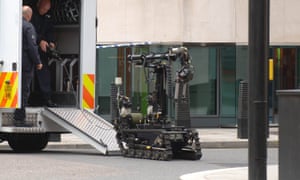
Bomb-disposal robots such as the one seen here have been used by the military as a weapon, according to Peter Singer of the New America Foundation, but never before by police.
Police’s lethal use of bomb-disposal robot in Thursday’s ambush worries legal experts who say it creates gray area in use of deadly force by law enforcement

For what experts are calling the first time in history, US police have used a robot in a show of lethal force. Early Friday morning, Dallas police used a bomb-disposal robot with an explosive device on its manipulator arm to kill a suspect after five police officers were murdered and seven others wounded.

“We saw no other option but to use our bomb robot and place a device on its extension for it to detonate where the suspect was,” Dallas police chief David Brown told reporters.

Peter Singer, a strategist and senior fellow at the New America Foundation who writes about the technology of warfare, said he believed this was a first. “There may be some story that comes along, but I’d think I’d have heard of it,” he said.

Others concurred. “As far as I know, it appears to be the first intentional use of a lethally armed robot by the police in the United States,” said Elizabeth Joh, law professor at the University of California at Davis.

This is not the first time a robot designed with other functions in mind has been used as a weapon, but this kind of repurposing has until now been limited to the military. Singer said that in the early 2000s, a solider he interviewed repurposed a surveillance robot called a Marcbot with a bomb. These robots aren’t autonomous, Singer emphasized – the Marcbot “is like a toy truck with a sensor and camera mount they’d use to drive up to a checkpoint”. But this soldier had improvised: “They duct-taped an explosive and you can figure out the rest. You can see the parallels here.”

Singer also said that he was “in no way, shape or form condemning” the DPD’s decision. Brown said the decision protected police officers on a night when their lives were at greater risk than usual. “Other options would have exposed our officers in grave danger,” Singer said.

Joh said she was worried that the decision by police to use robots to end lives had been arrived at far too casually. “Lethally armed police robots raise all sorts of new legal, ethical, and technical questions we haven’t decided upon in any systematic way,” she said. “Under federal constitutional law, excessive-force claims against the police are governed by the fourth amendment. But we typically examine deadly force by the police in terms of an immediate threat to the officer or others. It’s not clear how we should apply that if the threat is to a robot – and the police may be far away.” That, Joh added, is only one condition for the use of lethal force. “In other words, I don’t think we have a framework for deciding objectively reasonable robotic force. And we need to develop regulations and policies now, because this surely won’t be the last instance we see police robots.”

The “bomb robot” used is assumed to be the DPD’s bomb-disposal unit, a wheeled, remote-controlled (as opposed to autonomous) robot with a manipulator arm on top. “When there’s a suspected explosive device, a suspected IED, you have this device with a robotic arm and a gripper on it,” Singer explained. “You might use the device to open up a bag and see if there’s a bomb in it. You might use the gripper to disassemble the device in the classic Hollywood movie cut-the-wire way; you might shoot high-pressure water into it, and you might do a controlled detonation.”

That, Singer said, is why the department had explosives handy – sometimes the preferred way to deal with a bomb is to evacuate the area around it and use another bomb to blow it up.

Similar robots were used in the DPD’s showdown with a gunman who assaulted the department’s headquarters with guns and bombs almost exactly a year ago.

On the military side, such improvisations are both the solution and, increasingly, the problem. “We’ve seen insurgents improvise,” Singer said. “Literally this week, the Joint Improvised-Threat Defeat Agency [an agency within the Department of Defense whose purpose is to develop better ways for the military to respond to IEDs] got a $20m grant to defeat drone IEDs, not for missiles but for small commercial drones that you and I could buy, which are used by Isis for both surveillance and for explosive delivery.

“Technology is a tool,” Singer said. “Tools are used the way they’re designed, and then people improvise and find new uses for them.”

Thursday, July 7, 2016

Public Knowledge: “unlock the box”

Public Knowledge

The FCC’s proposal to “unlock the box” would stop cable companies from forcing their customers to pay rental fees for set-top boxes, which average $231 per household per year. Instead, cable companies would be required to also support third-party devices, such as TiVo and Roku. The proposal has received ample support from the public, device makers, independent and minority  programmers,  civil rights groups, copyright experts, content creators, members of Congress, and President Obama.


But members of Congress supported by the cable industry snuck in an unnecessary rider to a must-pass government funding bill that will require the FCC to conduct additional studies on the proposal.

remoteemail.jpg


This is simply a delay tactic from incumbents who want to maintain their stranglehold on the market. Congress instructed the FCC to reform the video marketplace 20 years ago, and the FCC has been working hard to do so. After multiple rounds of public comments on the proposal, the Commissioners are thoroughly examining and addressing the concerns of all stakeholders, and are preparing to move forward with a solution.

Consumers will pay at least $1.6 billion per month while we wait on unnecessary delays by Congress--and we've been keeping track of every second we wait. 

Click here to contact key Senators and your representatives in Congress to tell them to put a stop to this rider and eliminate the language in the Appropriations bill that will delay #UnlockTheBox. Let them know you are ready for choice and competition in the video marketplace, without delay. The necessary processes have been completed, and it’s time for the FCC to #UnlockTheBox. 

Tweet this: Tell Congress it's time to let the #FCC do its job and #UnlockTheBox, *without delay*: https://goo.gl/sb9Tmn

Thanks,

Public Knowledge


Wednesday, July 6, 2016

Tesla's fatal Autopilot accident: Why the New York Times got it wrong

In Saturday's New York Times, coverage of Tesla's Autopilot crash was framed as a failure of technology on the part of Tesla. But leaving out the context is misleading.


On the front page of Saturday's New York Times, the fatal accident that occurred when Joshua Brown's Tesla Model S, in Autopilot mode, failed to brake was featured in two articles examining the circumstances of the crash: the limits of Autopilot, and what it means for Tesla.

The problem is that, in this case, the reporting in the Times was incomplete and ignored the full context of the situation.

But the New York Times articles on Saturday, which were highly critical of Tesla and its CEO Elon Musk, failed to fully capture the context of the accident. Here's what the coverage got wrong:

Conflation of Autopilot with a self-driving car. The headline of the front page piece, "A Fatality in a Self-driving Car Forces Tesla to Confront its Limits" is misleading. While the car was in Autopilot mode—akin to an advanced cruise-control—it is not accurate to say that the car was self-driving. Tesla does not make a self-driving car, a fully-autonomous car, or a driverless car. The title sensationalizes the incident, and plays into the fear factor involved when new technology is released.

Not enough information on the caveats of driving with Autopilot. Autopilot is a new technology—and one that, Tesla acknowledges, is imperfect. It is optional, meant only for highway driving. Drivers using Autopilot are required to keep both hands on the wheel—there is an alert, similar to what happens if you don't wear a seatbelt, that goes off if a driver fails to do so. Autopilot drivers are instructed to be alert at all times while the system is enabled. 

Drivers are expected to re-engage by shaking on the wheel or pressing the brake when needed. In this case, Brown did not re-engage or apply the brake himself. It is also likely that he was not paying attention—a Florida Highway Patrol sergeant found a portable DVD player loaded with a Harry Potter DVD in Brown's Tesla. According to the AP, "Frank Baressi, 62, the driver of the truck and owner of Okemah Express LLC, said the Tesla driver was 'playing Harry Potter on the TV screen' at the time of the crash ... He acknowledged he couldn't see the movie, only heard it."

Prematurely insinuating that Tesla is to blame for the accident. One of the Times' pieces calls Brown "a victim of an innovation geared precisely to people like him." But the fact is, while we know that the accident happened during Autopilot, we still don't know what, exactly, went wrong. Until the US Department of Transportation's investigation is complete, it is inaccurate to blame the technology.

Few sources from the tech world. The Times quoted analysts from Autotrends and Edmunds, but no one from the AI or self-driving car world. This is a mistake. Since technology is so central to the story, to have no one from inside the tech industry leaves out the most important perspective on the issue.

Few real-world Autopilot drivers sourced. The Times' piece quoted one Autopilot driver who expressed concern for safety after the accident—and he had only used Autopilot in a loaner, not regularly. 

But over the last few weeks, I've spoken to half a dozen Autopilot drivers, all of whom have expressed a feeling of safety with the technology—even post-accident. When I talked to a few more directly after the fatal crash, they were unchanged in their opinion, and reinforced the fact that they keep their hands on the wheel while using the technology, as intended. Daniel Nasserian said the accident "doesn't concern me at all. The Autopilot feature is still in its infancy, and I think the media ran with the story because of how new the concept is. The amount of miles driven without a fatality on Autopilot still remains impressive compared to the human error factor."

Why does this matter? When a new technology is released, and malfunctions, there is often an overreaction and a rush to judgment. Cruise control, for example, is not perfect. Nor are air bags, which can kill a driver. Nor are seat belts, which can also be a cause of death. But each of these innovations are designed to protect drivers, and have been shown to save more lives than they take. Likewise, Autopilot is intended as a safety feature, and has a high success rate. This is the first known accident in 130 million miles driven, while, according to a 2015 report by the US National Safety Council, the estimated annual mileage death rate is 1.3 deaths per 100 million vehicle miles traveled.

Bryant Walker Smith, professor at the University of South Carolina, and an expert on the legal aspects of self-driving vehicles, makes the following point. "The article depicted Tesla/Musk as indifferent to safety rather than struggling with, and perhaps reaching a different conclusion about, the same issues that are bedeviling the rest of the industry."

"In my experience," said Smith, "the company is attuned to safety. Perfection is not possible, and every company is in some ways learning from its customers' experiences. Tesla's 'beta' labeling is candid about this—and may even reflect an effort to emphasize the need for caution to its users."

Smith said that the piece "seems to treat Autopilot as nothing more than a convenience feature with no safety benefits—and, indeed, safety detriments."

This is not to let Tesla off the hook. The company's blog post about the accident left much to be desired. It was slightly robotic and tone-deaf, attempting to address the tragedy while simultaneously celebrating and defending Autopilot's achievements. And TechRepublic is not a cheerleader of Tesla: we hold the company accountable to answer several critical questions regarding the timeline of the incident and what can be learned from the accident.

Smith poses the following questions, which we plan to cover as answers emerge:

  • Should Tesla have monitored its users more?
  • Should Tesla have more strongly communicated the limitations?
  • Should Tesla have designed and marketed these technologies much more as safety than convenience features?
  • Should the systems have been limited to a backup rather than primary role in directing steering and braking? Should the system have been named something more modest?
  • Why did Tesla wait to announce this crash?
  • Has it already updated its software to account for this scenario (and others)? If so, how?
  • Why was there a lag between the fatal accident and the public announcement?
  • What has Tesla learned from the accident?
  • Will the accident do anything to change Tesla's approach?
  • Still, it is important to keep the big picture in mind.


"What if Autopilot ultimately prevents more deaths than it causes? 

What if the lessons learned through this early deployment helps to advance the state of safety technologies much more quickly than they would otherwise develop?" said Smith.

"In these cases, introducing Autopilot may make sense," said Smith, "and may, indeed, save lives."

The New York Times has since published several more pieces on the Tesla accident, some of which include more details about how the crash occurred. But when such a prestigious publication prints something on the front page that leaves out key points that would tell the full story, we are at risk of misleading the public on a very important issue.


Tuesday, July 5, 2016

Achievement unlocked: NASA’s Juno spaceship is now in Jupiter’s orbit

Image result for NASA's Juno.
Nearly five years after it was first launched in August 2011, NASA’s Juno spaceship has finally entered Jupiter’s orbit. At 11:53PM ET/8:53PM PT, the space agency received confirmation that the spacecraft had turned on its main engine, which burned for 35 minutes to slow down and allow Juno to be drawn in by Jupiter’s gravitational pull.

It’s a monumental achievement for NASA: the feat saw Juno cover 445 million miles in space to get closer to Jupiter than any other spaceship in the history of mankind. It is now in a highly elliptical 53-day orbit around the giant planet.

Broadcast live streaming video on Ustream

The goal of this mission is to determine how much water is in Jupiter’s atmosphere, in an effort to learn about which planet formation theory is correct. NASA also wants to measure the composition and temperature of Jupiter’s atmosphere, and how its magnetic force field affects the atmosphere there.

Jupiter emits massive amounts of radiation and flings debris with great force; Juno will avoid these belts for most of its time in the planet’s orbit. But at the end of the 53-day cycle, it will be within close proximity of the planet’s equator – close enough to study the atmosphere and magnetic field.

At 12:30AM ET, the spaceship is scheduled to re-orient itself toward the sun to recharge its batteries. If the maneuver is successful, it’s in the clear. You can follow along by tuning into the livestream above.


What to expect from the Windows 10 ...

Anniversary Update

The unconventional evolution of Windows 10 continues with the upcoming release of the Anniversary Update, version 1607. It's not just a service pack. Here's what's new

windows-10-crowd.jpg
Microsoft wants you to think of Windows 10 as a service, where new features arrive as they're ready, and where regular updates are themselves a feature.

That's true in a sense, but Windows 10 is still Windows, a big and sprawling tangle of code that carries an implicit promise of backward compatibility. The "as a feature" part just means more frequent upgrades, which are now called "feature updates" to distinguish themselves from the cumulative monthly "quality updates."

On July 29, Windows 10 celebrates the first anniversary of its release. Four days later, on August 2, a new upgrade -- sorry, I mean feature update -- will begin rolling out to the 350 million or so devices already running Windows 10.

The Anniversary Update is, technically, version 1607, and it is far more than a service pack. In this post and the accompanying gallery, I offer a preview of what you can expect from this major update, based on near-final preview releases.

UPGRADING

Part of the unpleasant reality of Windows as a Service is the necessity for frequent installations of these large feature updates. Over the past few weeks, I've installed near-final Windows Insider preview releases on a dozen PCs, new and old. On newer hardware, with solid-state drives and modern CPUs, the upgrade process typically takes between 20 and 25 minutes (not counting download times).

On a three-year-old HP Stream 11, powered by an Atom processor, with minimal storage, and with only 2 GB of RAM, the entire upgrade process took about an hour. That's nearly a worst-case scenario, although it's certainly possible that some pre-2009 PC designs with slow conventional hard drives could take longer.

A bigger change is the way that Windows 10 version 1607 handles those monthly cumulative updates. This release still offers no way to defer those updates automatically (short of using Windows Update for Business Group Policy settings), but you can at least define an Active Hours period of up to 12 hours per day during which you normally use the PC.

During the Active Hours period, you should in theory be assured that Windows 10 won't automatically interrupt your work to install an update. If an update has been downloaded but not installed, you can manually set an alternative update time.

THE STEADILY EVOLVING USER EXPERIENCE

The signature elements of the initial release of Windows 10 were a direct repudiation of the radical changes introduced in Windows 8. Version 1607 retains the same basic design of Start, which mashes the Windows 7 Start menu with the Windows 8 Start screen.

That's not to say the Start experience hasn't been tweaked for this release, however. The new design incorporates a scrolling All Apps list that is permanently available, while the power button and shortcuts to frequently used folders shrink to a slim column of icons on the left.

That change echoes the design of the built-in Windows 10 apps, including Groove Music, Photos, and Mail & Calendar. Spoiler alert: If you dislike the hamburger button, prepare to grit your teeth as you use Windows 10 version 1607, because that interface element is omnipresent.

Since the release of Windows 8 nearly four years ago, Microsoft has been methodically moving user controls from the old Control Panel to the new Settings app. With version 1607, that work takes a major step forward. Several major groups of options, including networking, have now moved almost entirely to the new Settings app, and the new iconography, replacing the generic gear icons used in previous versions, adds to the sense that this version of Settings is a major update.

Another signature piece of Windows 10 is the notifications pane along the right side. This Action Center was frankly a bit of a mess in previous builds. But a few subtle changes in the Anniversary Update make it far more usable.

First, the Action Center icon moves to the right of the system clock, and a badge over the icon lets you know how many new notifications are available. In addition, you can now tweak notification settings on an app-by-app basis, with more intelligent grouping options.

CORTANA

I originally thought of Cortana as a novelty, but with the changes in version 1607 I find myself calling on her services more often, as a calculator, a translator, a bringer of sports scores and search results, and a package tracker. This is definitely not Siri, but it's also not exactly Google Now. Microsoft has created something unique with Cortana.

And if you don't like the idea of an intelligent personal assistant sitting on the Start menu, you can just say no. Cortana is still an opt-in feature, one that can be completely disabled (so that it works as a search box only) and even hidden from the taskbar completely.

EDGE AND EXTENSIONS

The new default browser for Windows 10, Microsoft Edge, arrived late in the original preview cycle, and it has been playing catch-up ever since.

The big news for version 1607, of course, is the arrival, at long last, of extensions. After a rocky start, the limited selection of preview releases seems to be working well. The LastPass password manager, which was the number-one request from many of my correspondents, does its job as expected, and the two Adblock extensions have the same strengths and weaknesses as on other platforms.

In current builds, Edge has been fast and smooth. In fact, it appears that Microsoft's goal with Edge is to make a browser that is essentially a clone of Google's Chrome. Even the extension format is Chrome-like.

The big question for Edge is whether these changes will be enough to spur developers into actively developing extensions and to convince end users that it's a "good enough" alternative to Chrome.

WINDOWS INK

Microsoft has been delivering support for digital pens and the ink datatype since the dawn of the Tablet PC in 2002. Those designs never took off. Version 1607 tries to reboot that feature with the introduction of the Windows Ink platform.

The Windows Ink Workspace, which appears when you click the pen icon in the notification area, feels very much like version 1.0, offering quick access to pen-enabled apps that are fun to play with but don't exactly feel sticky.

With its Surface Pro and Surface Book lines, both equipped with pens as standard equipment, Microsoft remains firmly committed to the idea of the pen as a first-class input device. Whether that vision becomes a reality is still very much an open question

There's much more in this release, of course, including a few surprise features that I call out in the accompanying gallery, and an updated suite of apps that I'll cover in more detail in a follow-up post..

The good news, based on my testing on multiple hardware platforms, is that this appears to be a solid, stable release.


Friday, July 1, 2016

GENE EDITING TECHNIQUE WILL CHANGE THE WORLD (BW)

Using Crispr and the Cas9 protein, this scientist made the discovery of the century...which one?

In the very best invention stories, the tinkerer spends years toiling in obscurity before the big breakthrough. Jennifer Doudna’s story is like that. The 52-year-old biochemist grew up in Hawaii, studied at Pomona College and Harvard, and later joined the faculty at the University of California at Berkeley. While the rest of the scientific world seemed fixated on DNA, the blueprint of all biology, Doudna built detailed maps of RNA, which had long been thought of as the loyal foot soldier following DNA’s orders. Doudna was trying to figure out more precisely what role RNA plays in human genetics—the various ways it can actually control genes. For years, DNA remained the focus of most everyone else’s research. “I definitely had some sleepless nights,” she says, “just wondering, Is this the right decision, should I be doing this?”

Then one day in 2011, Doudna was approached at a conference by a French microbiologist named Emmanuelle Charpentier, who wanted to talk about a phenomenon called Crispr. Until then, most biologists understood Crispr, assuming they’d heard of it at all, to be an antiviral system found in bacteria. The bacteria used it to identify invading viruses and activate special proteins that would bind to the viral DNA and snip it out. No one had successfully found a plausible way to adapt and re-create that bacterial process in a more complex biological system—like a human being. Whoever could pull that off might be able to cure diseases, alter the genetic code, and even change the human species. It all sounded like science fiction, of course, until Charpentier told Doudna that Crispr seemed to interact with a protein called Cas9 in an extraordinary way.

The two decided to join forces, and one year later published a study detailing how they’d adapted the Crispr-Cas9 editing technique to not just cut but paste genes into any bacteria—that is, customize a bacterium’s DNA makeup along whichever lines they chose, with little fuss. The technique was enormously promising. Editing the human genome had been possible for a few years, but slowly, imprecisely, and with great difficulty. Crispr-Cas9 might eventually make it almost as straightforward as the search-and-replace feature of a word processor. What if one day, using Crispr, we could edit out Alzheimer’s, schizophrenia, or cancer? Soon, the two scientists were onstage with Cameron Diaz, accepting the Silicon Valley-funded $3 million Breakthrough Prize in Life Sciences. They were on everybody’s shortlist for the Nobel prize, their work hailed as the great biotech advancement of the century. “I couldn’t have predicted it,” Doudna says.

That’s a nice story, but there’s another. It’s about Feng Zhang, a 34-year-old molecular biologist at the Broad Institute of MIT and Harvard. Zhang was born in China and raised in Iowa, and he quickly became a star at Harvard and Stanford, where he was obsessed with finding the perfect way to reprogram human cells. “I’ve always been focused on genome editing,” he says. In 2011, the same year Doudna met Charpentier, Zhang attended a conference at the Broad Institute, in the same building as his lab, and heard a speaker offhandedly mention the Crispr immune system in bacteria. Zhang read everything he could find on the subject. He fixated particularly on a Canadian biologist’s 2010 paper noting the exceptional utility of the Cas9 protein.

Zhang spent months testing Cas9 enzymes, and was preparing to publish his findings in 2012, when Doudna and Charpentier’s paper came out. In Zhang’s paper, published a few months later, he showed how he’d successfully harnessed Crispr with Cas9 to edit a gene in a eukaryotic cell—that is, a cell with a nucleus. In the eyes of some, that distinction vaulted him ahead of Doudna and Charpentier. To edit a bacterial gene, the way Doudna had, was one thing; to actually monkey with the building blocks of humanity was another.

Every decade or so, a fundamentally new genetic technology comes along that could change everything. In the 1970s it was restriction enzymes, the tools for recombinant DNA, which turbocharged the development of new medicines and the tools of basic biological research. In the ’80s, the polymerase chain reaction revolutionized day-to-day molecular biology by making it much easier to quickly copy a piece of DNA thousands of millions of times, speeding the pace of medical research even further. In the ’90s, next-generation DNA sequencing pushed forward the study of the genome to a level once thought impossible. Now there’s Crispr, which could trounce them all.

The name, coined in 2002 by Spanish researcher Francisco Mojica, is short for clustered regularly interspaced short palindromic repeats (you can tell somebody really wanted to spell “Crispr”). Today it’s understood to be, potentially, a cheap and quick way to fix anything about a genetic code. “It’s almost as fundamental as the transistor,” says Andrew May, the chief scientific officer at Caribou Biosciences, a Crispr startup co-founded by Doudna in 2011. “If you think of DNA as the fundamental sort of software code that underpins the computer that cells are, you’re essentially programming those cells. You can target any piece of DNA and change it.”

In the popular imagination, Crispr has prompted alarmed speculation about eugenics, designer babies, and hubris worthy of Jurassic Park. The results may be able to change inheritable traits that could forever alter the nature of any species—not just mosquitoes, which a British company named Oxitec plans to tinker with in the Florida Keys using a gene-modifying technique that predates Crispr. Researchers in China have already tried out Crispr-Cas9 on human embryos. They never intended to implant the embryos in mothers and reported mixed success at best. Yet the attempt shook many in the scientific community. In June, a federal biosafety and ethics panel approved human trials of Crispr-Cas9 by a University of Pennsylvania team that has the backing of Napster co-founder and itinerant entrepreneur Sean Parker. Home hobbyists, meanwhile, are using Crispr to fiddle with yeast in petri dishes, splicing together who-knows-what. Harvard researcher George Church appears serious about a plan to use Crispr to bring back the woolly mammoth.

Nearer-term advances could change our lives in more welcome ways. Researchers around the world see Crispr’s precision as a perfect tool for curing single-gene illnesses like Duchenne muscular dystrophy, cystic fibrosis, and an inherited form of blindness called LCA 10. “There are 6,000 or so genetic diseases, and 95 percent of them don’t have any proved therapies,” says Katrine Bosley, chief executive officer of Editas Medicine, a Cambridge, Mass., Crispr startup. “In this day and age, we have a deep knowledge of the human genome and how to make genetic medicines that we didn’t have 5, 10 years ago.”


AstraZeneca and Novartis have teamed up with Crispr startups to develop and bring drugs to market. Beyond cures, Crispr is being viewed as a way to make cancer drugs more effective, to build a better class of antivirals to fight HIV, and to modify pig organs to make them more suitable as transplants for humans. In just a few years, the technique could make its way into everything from medicine to agriculture to biofuels—anything involving a gene. Imagine genetically modified crops that, with Crispr’s assistance, don’t use any genes other than their own, sidestepping the GMO controversy. DuPont is already working with Caribou on mushrooms that stay white after being cut, and told Doudna it has 25 Crispr-related products in the pipeline, including corn, soybeans, wheat, and rice.

For a time, Zhang and Doudna were cordial. Along with a few other molecular biologists, they joined the board of Editas. Then, in 2014, the federal government granted Zhang the first patent on Crispr-Cas9. Although Doudna and Charpentier enjoyed a wave of glowing press, Zhang stood to get the money and, maybe, the spot in the history books. Doudna left Editas a month later; though she says the reason was too many cross-country commutes for board meetings, she helped found a new startup, Intellia Therapeutics, that would be directly competing for venture capital. The race for funding was on. Bill Gates and Google Ventures were among the contributors to Editas’s $120 million Series B investment round—Gates is particularly enthusiastic about altering entire mosquito populations to stop malaria—and the company netted an additional $94.4 million in a February initial public offering. Intellia, in turn, raised $112.9 million when it went public in May. Charpentier’s Crispr Therapeutics has yet to go public but has raised $198 million in venture funding and has contracts with Bayer and Vertex Pharmaceuticals worth a combined $440 million. “All I can say is that we did it in my lab with Jennifer Doudna,” she told one reporter in 2014. “I am very confident that the future will clarify the situation.” All told, Crispr companies have attracted more than $1 billion of venture capital and other funding, even as credit for the technology and its relevant patent remain a matter of dispute.

Next came the litigation. In 2015, UC Berkeley’s lawyers filed a claim on behalf of Doudna with the U.S. Patent and Trademark Office, seeking to strip Zhang and the Broad Institute’s hold on Crispr-Cas9. Proceedings began this spring, but the most dramatic part is still to come. In November, Doudna and Zhang may have to take the stand, each asserting under oath that she or he deserves the patent for what may well be the biological advancement of our age. The stakes are sky-high. Billions of dollars in revenue. Control over entire industries yet to be born. And, perhaps, the future of human evolution.

“I’m really an outsider to the genome-editing field,” Doudna says. “Other folks, they’ve been in this field, whereas we’re coming at this from a very different point of view.” It’s late on a Friday afternoon at UC Berkeley, and Doudna, tall and thin and cheerfully focused, is seated in her office with a sweeping view of the campus, fiddling with a 3D-printed model of the Cas9 protein—a plastic toy, really, a bit larger than a football—that she keeps nearby to explain the Crispr technique to visitors. She still marvels at Crispr’s utility as “a democratizing technology. It just opens the door to anybody who has basic skills in molecular biology and wants to do some genome editing.” That includes those who might want to customize a newborn’s genes. Doudna has helped lead the effort to encourage ethical uses of Crispr, but she’s not for a complete moratorium on human experimentation. “On one hand, you can say maybe it’s not right to do that ever, but you can also say in vitro fertilization clinics already do that every day.” Her lab is working on curing the neurodegenerative disorder known as Huntington’s disease.

The only part of her Crispr story Doudna hesitates to comment on is the battle for credit. For two years, UC Berkeley and the Broad Institute have engaged in a simmering public-relations war over who invented the Crispr-Cas9 method, each spinning its version in press releases and video primers. For her part, Doudna says her work with RNA molecules made her research distinctive. Everyone else, she says, was looking at DNA. That would include Zhang. “What I’ve always found interesting in science,” she says, “is making connections between things that are not necessarily connected or don’t appear to be connected.”

“On one hand, you can say maybe it’s not right to do that ever, but you can also say in vitro fertilization clinics already do that every day"

Across the country, Zhang’s lab in Cambridge is at the Broad Institute in Kendall Square, the world nexus of biotech investment and research, a five-minute walk from Editas’s offices. When I visit a week after meeting with Doudna, Zhang greets me with a warm, confident smile. Boyish and upbeat, he’s eager to discuss his lab’s latest advances in Crispr techniques: the methods he’s found to make the editing more precise; his ambition to map out complex brain diseases like Alzheimer’s; the protein he found that works as well as Cas9 and which he owns the patent to, free and clear. If Doudna is an outsider to the gene-editing world, Zhang is a native, an Intel Science Talent Search finalist who’s been devoted to the idea of reprogramming DNA since 1993, when an after-school program in Des Moines took him to see Jurassic Park.

Unlike Doudna, who badly wants to shape the way the public thinks about Crispr, Zhang isn’t interested in ethical conversations about designer babies, which he says are a long way off. “The thing everybody should focus on is how we can push this technology forward, so we can actually treat a disease,” he says.

Zhang is as quietly focused as Doudna in asserting his ownership of Crispr. Without ever saying her name, he argues that her big Crispr paper with Charpentier didn’t actually scoop him, because they stuck with bacteria and used the Cas9 protein in a different way. “You have to test it in the actual system that you want to get it to work in,” he says. “Nothing else is going to be able to fully predict what will happen.”

The entire Harvard and MIT apparatus appears to have lined up behind Zhang’s version. In January, Eric Lander, president of the Broad Institute, published an elaborate history of Crispr in the journal Cell that spread credit around to a host of researchers over years. The effect, more than one Doudna supporter protested, was to vastly downplay her contribution. Amid the tempest that followed, Doudna called Lander’s article “factually incorrect.” Still, Lander’s broader point—that today’s discoveries are often an ensemble effort—does resonate with Doudna. “I wouldn’t disagree with that, yeah,” she says.

Does it follow, then, that the patent system should allow people to share credit? Doudna takes a moment before answering. “It’ll probably be a while,” she says, “before I have enough perspective that I can really answer that question.”


Many were surprised that Zhang received the Crispr-Cas9 patent, given that Doudna published first and filed for her patent seven months ahead of him. The reason: Zhang had paid $70 to have his application expedited. Some have interpreted that as a slimy move; the patent lawyers and experts I spoke with say that may have been his only option to avoid his application being deemed in conflict with Doudna’s. In any case, almost immediately after Zhang got his first patent on April 15, 2014, UC Berkeley amended Doudna’s application to counter his claim. Then a few third parties, their identities still not made public, filed briefs to block Doudna. The patent war had begun.

The Broad Institute produced lab notebooks and private e-mails to bolster its case that Zhang’s idea was original and that Doudna’s predictions that Crispr-Cas9 would work in humans was “mere conjecture.” UC Berkeley claimed Zhang’s notebooks were missing key information, going so far as to say the Broad Institute “withheld or misrepresented material information with the intent to deceive” the patent office. Preliminary meetings with a judge this spring generated more heat than light, and UC Berkeley’s objections failed to get any traction. Next, in what’s called the interlocutory phase, a panel of three patent judges will be handed the task of determining who invented Crispr-Cas9.

“The Berkeley lab is going to say they had the building blocks,” says Sarah Chapin Columbia, an intellectual-property litigator with McDermott Will & Emery in Boston. “The MIT-Harvard lab is going to say, ‘We put the building blocks in the right orientation.’ To a patent geek, that’s going to be a very interesting thing to watch.”

There’s one more major quirk. The entire dispute, called an “interference” case because the patent claims are said to interfere with one another, is moving forward based on a set of rules that have been changed since it was filed. Under the old rules, the scientist deemed the “first to invent” wins. Under the new rules, the patent goes to the “first to file,” matching the system in many other countries. The new system operates under the assumption that the early filer will be the best able to build an industry around the invention, says Kevin Noonan, a biotech patent expert and partner with law firm McDonnell Boehnen Hulbert & Berghoff in Chicago. “So these days we don’t care so much if the right person gets the patent,” he says. “It may not be more fair, but it’s simpler.”

Even if the current patent system encourages innovation, the rules hardly seem fair to the inventors—or true to the reality of invention itself. Does this process accurately reflect the way people from Thomas Edison and Nikola Tesla on down have tended to invent things in parallel? Science thrives when scientists share data and ideas, but the winner-take-all patent system almost forces scientists to guard their best stuff. And when patents are contested, the proceedings can be brutal. “Every piece of evidence has to be independently corroborated by somebody who swears under oath that it’s true,” Noonan says. “Too often, things can get shaded, because your recollections are not consistent with reality. Especially when having those recollections means you make a lot of money.”

The best thing you can say about the process, perhaps, is that it can motivate people to settle for some sort of cross-licensing arrangement. “That’s really the smart thing to do,” Noonan says. “If they settle, then they both win.” If one party wins, appeals could last years. There’s always the possibility the panel of judges will award the patent to neither party. And the longer they battle over the patent, the more risk to its licensing value. Zhang isn’t the only researcher trying to invent a way around this patent, finding proteins besides Cas9 that work with Crispr. The search is moving quickly: In June, the journal Science published a study showing how the technique could be used to manipulate not just DNA but RNA, too. And the patented version may well fail human clinical trials or face years of delays like gene therapy did after 1999, when one of the volunteers in a human trial died.

Yet an April filing in the case showed the parties have discussed settling and held off. For now, the various Crispr companies’ investors are holding tight. “We knew it was high-risk,” says Kevin Bitterman of Polaris Partners, the venture firm that helped form Editas with Flagship Ventures and Third Rock Ventures. “We did a lot of due diligence on the intellectual property and feel very confident in the company’s position.”

It’s not possible with any degree of certainty to pick the eventual winners. “Every investor in the Crispr space thus far is essentially betting on a horse race,” says Jacob Sherkow, a New York Law School professor who is following the dispute. “If you’re paying Caribou Biosciences for a license on their technology”—that is, the technology Caribou licensed from Doudna—“you’re essentially gambling on them winning. And if Caribou loses, then you never had to pay that money. But you know, it’s a transformational piece of technology. So it’s better to get in on it now than to wait. There’s that Warren Buffett quote—‘If you wait for the robins, spring will be over.’ ”

Patents might not be the most important front in the Crispr war. They’re good for only 20 years, after all; history is forever. The Nobel committee typically honors no more than three people per discovery, no matter how many actually worked on it. Doudna, Charpentier, and Zhang aren’t the only contenders: Media reports have also lauded Harvard’s Church, DuPont’s Philippe Horvath, and Rodolphe Barrangou of North Carolina State University for their work on Crispr.

“There’s a lot of competition,” Doudna says. “It’s true in any human endeavor. People get excited about an idea, and then a lot of people go after it.” She’s flattered but a little worried about the flurry of attention. “It would be so easy to get so distracted by all this stuff going on that I would never really do any real science again,” she says. “That’s actually my worst nightmare.”

Still, she knows the real advancements require money. “Is a cure for Huntington’s going to come from an academic lab?” she asks. “I mean, it’s just not going to. Do we have the resources to do clinical trials and all of the work to figure out really how to deliver this as a drug? No. That has to be done in a commercial setting.” So she’s embracing the commercial aspects of Crispr. “I want to see this used. I want to see it really solve real problems. I don’t care who does it, but if somebody has a cure for an eye disease or for a sickle-cell trait or for something like that, it’s going to be fantastic. That’s what I would love to see happen.”

Zhang is similarly fixated on perfecting the invention. “There’s so much hype around this, and there are so many things we have to work out,” he says. “How safe is the system in the body? How do we put it in the right organ? We have to work on resolving those questions. And all these other issues, they are really beside the point.”

How uncomfortable is it to be caught in the middle of a highly visible struggle over a major scientific legacy? “I didn’t start to work on this because I wanted to get a patent,” Zhang says. “If we can treat a disease, I mean, that’s what moves the world forward. It’s not patents or credit or anything like that.”

When I tell him Doudna says almost the same thing, he takes a long pause. Finally, he answers. “For me, I think the primary goal is to do something useful,” he says. “I think if you actually do something useful, you’ll get rewarded. The world will recognize the value you created, and the world will be a fair place.”